Point-of-care testing is laboratory testing that happens elsewhere
Point-of-care testing governance starts from one premise: a glucometer reading at a bedside is a laboratory result. It informs an insulin dose, it goes in the chart, and it carries the same consequences as a result from the main analyser. The fact that it was produced by a nurse on a handheld device in a ward changes the operational model, not the standard it must meet.
Hospitals accumulate POCT devices without deciding this. Glucometers arrive with a diabetes programme, blood gas analysers with the ICU, urine analysers with OPD, rapid coagulation devices with the cath lab, and rapid infectious disease tests with the emergency department. Each was bought for a good reason by a department that did not think of itself as opening a laboratory.
The result is a distributed testing operation with no inventory, no operator list, no quality control, and results that may or may not reach the record. Accreditation assessments cover POCT under the same quality framework as the central laboratory, which is where many hospitals first discover how much of it they are running.
Start with an inventory nobody has
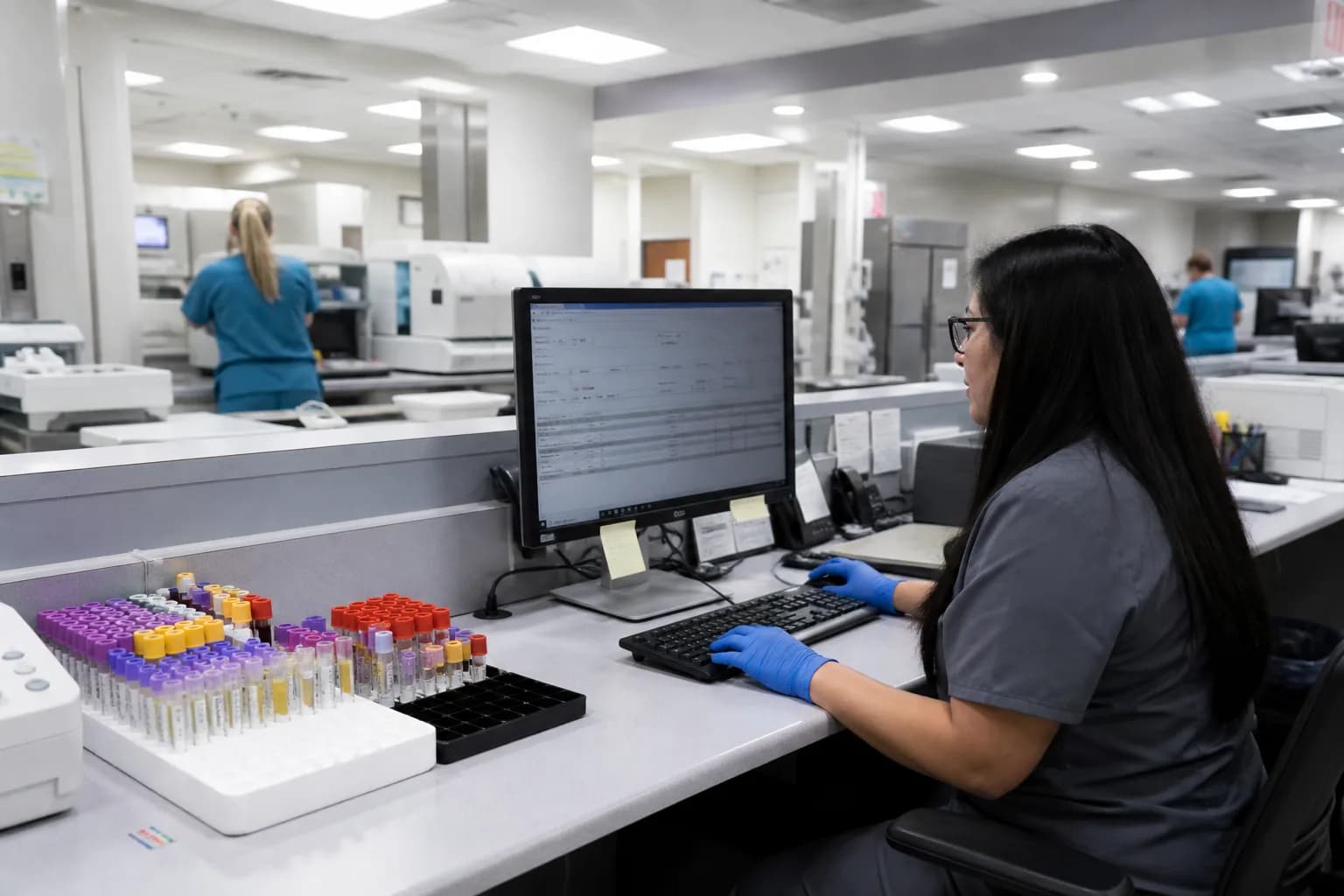
The first governance action is a physical census: every device capable of producing a diagnostic result outside the laboratory, where it is, who bought it, what it tests, and whether anyone is doing quality control on it. Expect the count to exceed the estimate, and expect to find devices in departments that did not appear on the initial list.
For each device the register should record the make and model, serial number, location, responsible department, the tests it performs, its maintenance status, and the reagent or strip lot currently in use. Strip and cartridge lots matter more than people expect, because expired or mis-stored consumables are the most common cause of POCT error and are invisible in the result.
The census usually surfaces devices that should not exist — personal glucometers brought in by staff, devices donated during a programme and never commissioned, and duplicates of a model the hospital standardised away from. Rationalising the fleet to fewer models is itself a quality intervention, because training, quality control, and connectivity all get simpler.
Fields the POCT device register needs
- Device model, serial number, and permanent location
- Responsible department and named device custodian
- Tests performed and the reportable range for each
- Current consumable lot and its expiry
- Quality control schedule and last performed date
- Connectivity status and whether results reach the patient record
Operator certification and recertification
POCT is performed by clinical staff whose primary role is not testing, which means competence cannot be assumed from professional registration. Operators need initial training on the specific device, an assessed competency, and periodic reassessment — the same structure the central laboratory applies to its own staff, scaled to the simpler task.
The practical control is device-level operator lockout. A device that only accepts a valid operator identifier prevents uncertified staff from producing results and makes every result attributable. Without lockout, the certification list is a document rather than a control, and rotating or agency staff will use the device regardless.
Recertification intervals should reflect frequency of use. A nurse who performs a test twenty times a week retains competence differently from one who performs it twice a year, and the low-frequency operator is the higher risk. Some hospitals resolve this by concentrating certification in fewer staff per shift rather than certifying everyone.
Connectivity: getting POCT results into the record
A POCT result written on a chart by hand is a result that will not appear in trend views, will not trigger clinical decision support, cannot be audited, and may be transcribed wrongly. Connectivity — docking stations, wireless upload, or middleware — is what turns POCT from a parallel record into part of the record.
Connected results need to be distinguishable from central laboratory results in the chart, because their analytical characteristics differ. A bedside glucose and a laboratory plasma glucose are not interchangeable at clinical decision boundaries, and a trend graph that mixes them without indication invites misinterpretation. Labelling the source is a minimum, not a refinement.
Connectivity also delivers the governance data that manual POCT cannot: which devices are actually in use, which operators are testing, when quality control was last run, and where consumable lots are expiring. A platform such as HealUDoc can receive POCT results into the patient record with device and operator attribution, which means the quality team gets its oversight data as a by-product of clinical use rather than as a separate collection exercise.

Quality control on handheld devices
Handheld devices need quality control on a defined schedule, on new consumable lots, after maintenance, and whenever a result does not fit the clinical picture. The frequency should be stated by the laboratory rather than left to the ward, and the results need to be recorded somewhere retrievable — which in practice means device memory uploaded through connectivity, because paper QC logs on wards do not survive.
Electronic or internal checks built into a device are not a substitute for liquid quality control, though many staff assume they are. The internal check confirms the instrument electronics; it does not confirm the strip, the lot, the storage conditions, or the operator technique. Both are needed and the distinction should be explicit in the procedure.
Out-of-range quality control on a ward device needs an action rule that ward staff can follow: stop using the device, use the named alternative, notify the custodian, and do not report the patient result obtained on the failed device. Without a stated alternative, staff will keep using the device because the clinical need does not pause.
Correlation with the central laboratory
POCT devices should be periodically compared against the central laboratory method using split samples, because the two are used interchangeably by clinicians whether or not the laboratory intends it. The comparison establishes whether the difference is within acceptable limits and gives the laboratory a defensible answer when a clinician reports a discrepancy.
Discrepancy investigations are frequent and are a good source of quality signal. A bedside glucose that differs substantially from a simultaneous laboratory value may reflect device error, technique, sample source, or genuine physiology — and separating those requires the correlation baseline to exist beforehand. Investigating without it produces opinion.
Where a hospital runs the same POCT model across several branches, correlation should be performed per device rather than per model. Devices drift individually, and a model-level comparison conceals the one unit that is out of line.

Who owns POCT quality
The ownership answer that works is a POCT committee chaired by laboratory leadership with clinical department representation, holding authority over device procurement, certification, quality control, and connectivity. The laboratory owns the quality standard because that is where the expertise sits; the clinical departments own execution because that is where the testing happens.
Procurement authority is the part that decides whether governance is real. If a department can buy a testing device without the committee, the register will be permanently incomplete and the quality framework will always be catching up. Routing all diagnostic device purchases through the committee is a small administrative step with large downstream effect.
The committee's standing agenda should be short and consistent: register changes, certification status, quality control compliance, correlation results, incidents, and consumable lot issues. Reviewed quarterly, this keeps POCT visible between accreditation cycles rather than becoming a pre-assessment scramble.
“We counted eleven devices in the initial list and found twenty-six. The ones we did not know about were the ones with no quality control at all.”