The decision in one paragraph
Nobody should build the video layer. Real-time media is a specialised discipline with genuine engineering depth, and a hospital IT team writing signalling servers and turn relays is spending its scarce capacity on the one part of the problem that is a commodity. The actual build-versus-buy decision is about the workflow layer above the video: identity, scheduling, the clinical note, the prescription, the payment, and the record. That is where the choice matters and where the hidden costs live.
Framed that way, the two real options are extending your existing hospital management system with an embedded video capability from a communications provider, or buying a standalone teleconsultation platform and integrating it back into the HMS. The first keeps the record in one place and makes you responsible for the workflow. The second gives you a polished patient-facing experience quickly and makes you responsible for the joins.
The right answer depends less on features than on two things: how good your HMS vendor's integration surface is, and whether you have the internal engineering capacity to own an integration for years rather than months. Hospitals answer the first question carefully and the second one optimistically, which is why so many standalone platforms end up as data islands with a manual reconciliation process behind them.
Questions that settle the decision faster than a feature matrix
- Does your HMS vendor expose a documented API for encounters, orders and billing
- Do you have named engineering capacity to own an integration for three years
- Who is accountable when a consultation exists in one system and not the other
- How quickly does each route let you produce a complete record on request
- What happens to the teleconsultation data if you change either vendor
What extending the HMS actually involves
Extending the HMS means the teleconsultation is an encounter type inside the system you already run. The appointment, the queue, the clinical note, the prescription, the bill, and the record are all native. A doctor moves between a physical OPD patient and a remote one in the same worklist without changing application, which sounds like a small thing and turns out to be the largest single determinant of consultant adoption.
The work is real but bounded: embed a video software development kit, add mode and consent fields to the encounter, add the prescribing tier controls, build a patient-facing join link that does not require an app install, and handle the waiting-room state. The heavy lifting is in the states nobody demonstrates, particularly the patient who joins early, the doctor who runs late, the call that drops, and the consultation that has to be rescheduled after payment.
The trade-off is speed and polish. Your HMS vendor's teleconsultation module, or your own extension of it, will almost certainly look and feel worse on a patient's phone than a purpose-built consumer product does. If your service is aimed at existing patients of the hospital who already trust you, that gap costs you little. If you are trying to acquire new patients through a digital channel, it costs you a great deal.
What a standalone platform gives you on day one
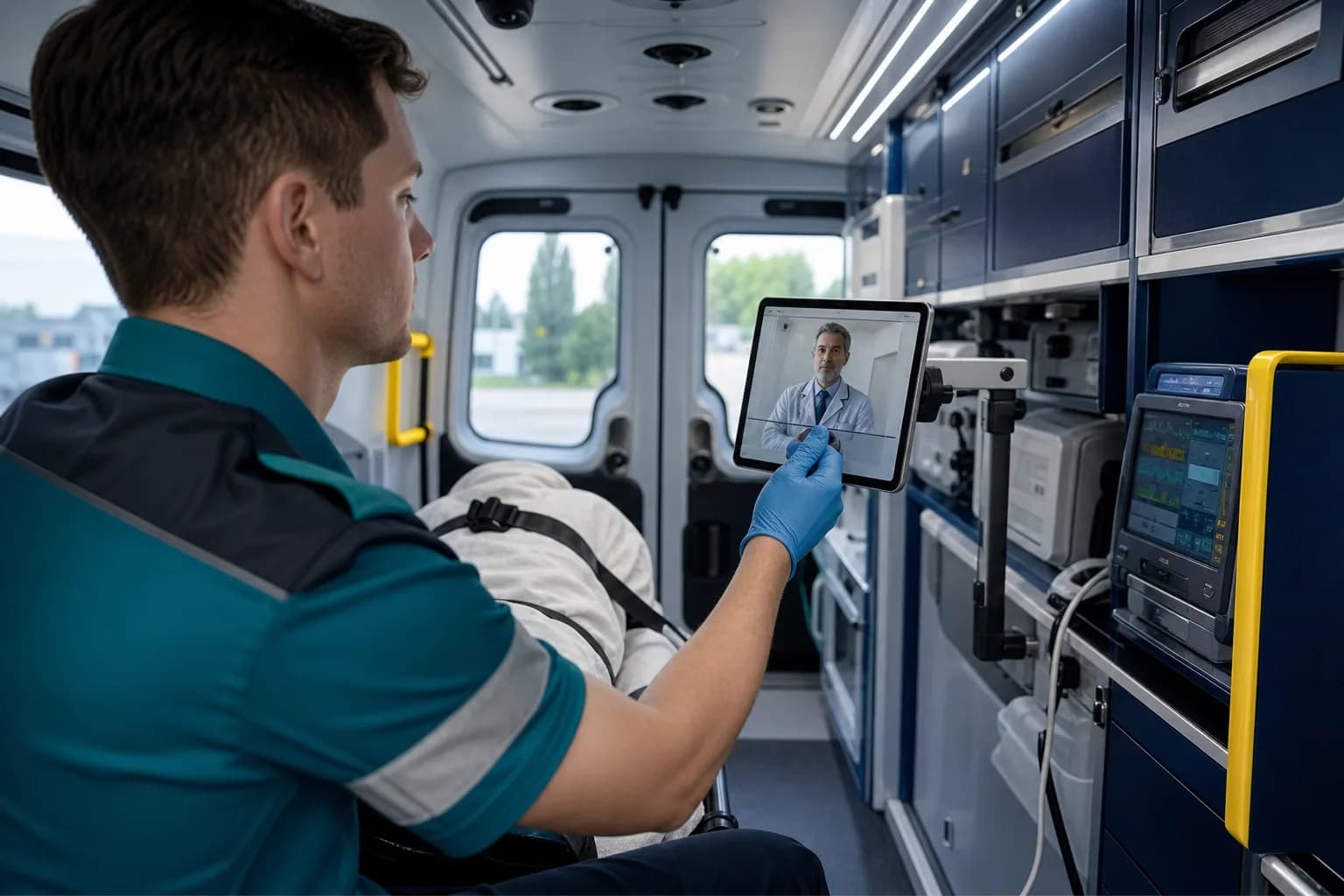
A standalone platform buys time. You get a tested patient onboarding flow, a call experience that works across a wide range of phones and browsers, payment collection, reminders, and usually a doctor app, in weeks rather than quarters. For a hospital that needs a service running before the next quarter, this is a legitimate and often correct choice, particularly for a first pilot where the goal is to learn what your patients and consultants actually do.
It also puts the operational burden of the media layer on someone else. Call quality complaints, browser compatibility, mobile operating system updates that break something, capacity during a surge: all of that becomes a support ticket rather than an engineering incident. For a small IT team this is worth more than it appears on a feature comparison.
The cost is that you now have two systems with overlapping truth. Every patient, every encounter, every prescription, and every payment exists in a place your HMS does not know about until an integration tells it. Whether that is a manageable seam or a permanent operational wound depends almost entirely on the four joins discussed next.
The four joins that decide whether a standalone platform works
- Patient identity: mapping platform accounts to your UHID without creating duplicates
- Encounter: getting the consultation and its note into the medical record
- Prescription: a single prescription of record rather than two versions
- Money: consultation fees reconciling against your billing and doctor payouts
- Consent and audit: one retrievable trail spanning both systems
Patient identity: the join that decides everything
Standalone platforms almost always create accounts keyed on mobile number, because that is what works for consumer onboarding. Hospital records are keyed on a UHID created at a registration desk from a name, an age, and whatever identification the patient produced. These two identity models do not match, and the mismatch generates duplicates at a rate that grows with volume. A patient who books online with her own number and previously registered with her husband's number becomes two people.
The mitigation is a deliberate matching step rather than an automatic one. Match on mobile number plus name and date of birth, and where the match is ambiguous, route it to a human at the registration desk before the consultation rather than after. Where an ABHA Number is present on both sides it resolves the case cleanly, but coverage is not universal enough to rely on as the primary key yet.
Decide early which system is the master. Almost always it should be the HMS, with the platform holding a foreign key back to the UHID. The failure pattern to avoid is bidirectional creation, where both systems can mint new patients and a reconciliation job tries to sort it out nightly. That job will run for years, it will never be finished, and your duplicate rate will be a permanent line in your data quality report.
“Eleven months in we had about nine thousand platform accounts and around seven thousand real patients. Untangling that cost more than the platform licence did.”
Billing, receipts and the revenue leak nobody predicts
Teleconsultation money behaves differently from OPD money and the differences are all edge cases. Payment is taken before the service is delivered, which inverts the normal hospital sequence. Refunds happen for reasons that do not exist at a physical counter, such as a call that never connected. Doctor payout shares have to be computed on a fee collected by a gateway rather than a cashier. And the receipt has to be consistent with how the rest of your outpatient billing is treated for GST.
If the platform collects the money, you now have a settlement problem: gateway payouts arriving net of charges on a different cycle from your daily cash reconciliation, with the split between hospital share and doctor share computed somewhere outside your finance system. Ask the finance team to walk through a month-end close for the teleconsultation line before you sign, not after. They will find things the demonstration did not cover.
The leak that surprises people is unbilled consultations. A doctor takes a call outside the platform because the patient could not join, delivers the consultation, and no charge is ever raised. This is common enough at every hospital that runs a remote service that it should be measured deliberately. Count consultations recorded against consultations billed, monthly, and investigate the gap rather than assuming it is zero.
ABDM linkage and the record you must produce
If your hospital is registered as a health information provider under the Ayushman Bharat Digital Mission, teleconsultations are care contexts like any other and should be linkable to the patient's ABHA. That means the encounter has to be assembled as structured output conforming to the national implementation guidance, with a consent flow behind any sharing. A teleconsultation living in a standalone platform with no ABDM capability is invisible to that whole architecture.
Ask a specific question of any standalone vendor: can it produce the structured bundle for a teleconsultation encounter, or does it expect your HMS to do that from data it pushes across. Both answers are workable. Neither answer is nothing, and nothing is what you will get if you ask whether the product is ABDM compliant, because that phrase has been claimed by products at very different levels of actual capability.
The same applies to record production for any other reason: a consumer complaint, a council inquiry, an insurance query, a NABH assessment. The test is simple and you should run it during evaluation. Ask each candidate architecture to produce a complete, timestamped record of one teleconsultation, including consent, mode, note, prescription, and who accessed it. If that requires exporting from two systems and stapling them together in a document, you have learned something important.
Costing both routes honestly over three years
Compare on three years, not on implementation cost, and include the lines that vendors do not quote. For the standalone route: licence or per-consultation fees at your projected volume, integration build, ongoing integration maintenance when either side releases, the finance reconciliation effort, and the internal support burden of a second system. For the extend route: development effort, communications provider usage charges, the opportunity cost of what your team is not building instead, and the risk that your HMS vendor's roadmap does not match yours.
Add the exit cost to both. If you leave the standalone vendor in year three, what happens to the consultation records, the recordings, and the patient accounts, and is there a contractual export obligation with a defined format? A great many hospital contracts are silent on this, which is another way of saying the data stays where it is. Negotiate it at signature when you have leverage.
Also price the data-protection work, because it is not free in either direction. Under the DPDP Act a standalone platform processing patient data on your behalf needs a written arrangement covering purpose, security, breach notification, and deletion, and someone in your organisation has to hold that relationship. HealUDoc can carry the teleconsultation encounter natively alongside physical visits, which removes the identity and record joins entirely, but the honest framing is that this is a trade of integration risk for dependence on a single system rather than a free lunch.
Three-year cost lines to demand from both routes
- Licence or per-consultation charges modelled at year-three volume, not pilot volume
- Integration build plus a realistic annual maintenance allowance
- Finance reconciliation effort in person-days per month
- Data-protection contracting, security review and breach-handling obligations
- Exit and data export terms, in a defined format, written into the contract