Mass casualty and disaster triage planning starts with activation
Mass casualty and disaster triage planning is tested almost entirely in the first ninety minutes, and the decision that determines everything afterwards is when to activate. Hospitals hesitate because activation is disruptive and expensive, and that hesitation is the most consistently identified weakness in post-incident reviews. A plan that requires senior consensus before activation will always activate late.
Give a single, always-present role the authority to activate — typically the senior emergency physician on duty or the duty administrator — and make explicit that activating on incomplete information is the expected behaviour. De-escalation should be equally easy and equally blameless; a plan that can be stood down in ten minutes at no cost to anyone's standing will be activated when it should be. Write the no-fault activation clause into the plan in the same paragraph as the authority.
Design activation in tiers rather than as a switch. A first tier that alerts the emergency department and clears its majors area, a second that recalls staff and opens additional areas, a third that converts elective capacity — each with a defined trigger and a defined set of actions. Tiering means the plan can be used for the incident that brings six patients, which is the incident that actually happens, rather than only for the catastrophe it was written for.
Surge capacity: what you can actually open, and how fast
Surge capacity is not a number on a plan; it is a set of specific spaces with specific readiness times and specific limiting factors. Work out, for each area you intend to convert, how long conversion takes, what equipment must be moved, whether the area has adequate oxygen and suction outlets, and who does the physical work. A day-care area that looks convertible on a floor plan may take two hours because the beds are stored in another block.
Almost always the binding constraint is staff, not space, and specifically staff with critical care competence. A plan that opens twenty additional beds without accounting for who will nurse them creates a hazard rather than capacity. Be honest in the plan about the ratio you can sustain during surge and how long you can sustain it, because a realistic constraint stated in advance is far better than an aspirational one discovered at hour three.
Rehearse the physical conversion at least once, in real time, with the actual staff. The rehearsal will find the locked store, the missing trolley key, the oxygen manifold that needs an engineer, and the door that will not admit a bed — none of which appear in any plan review. Time the conversion during the drill and put the real figure into the plan, replacing the estimate.
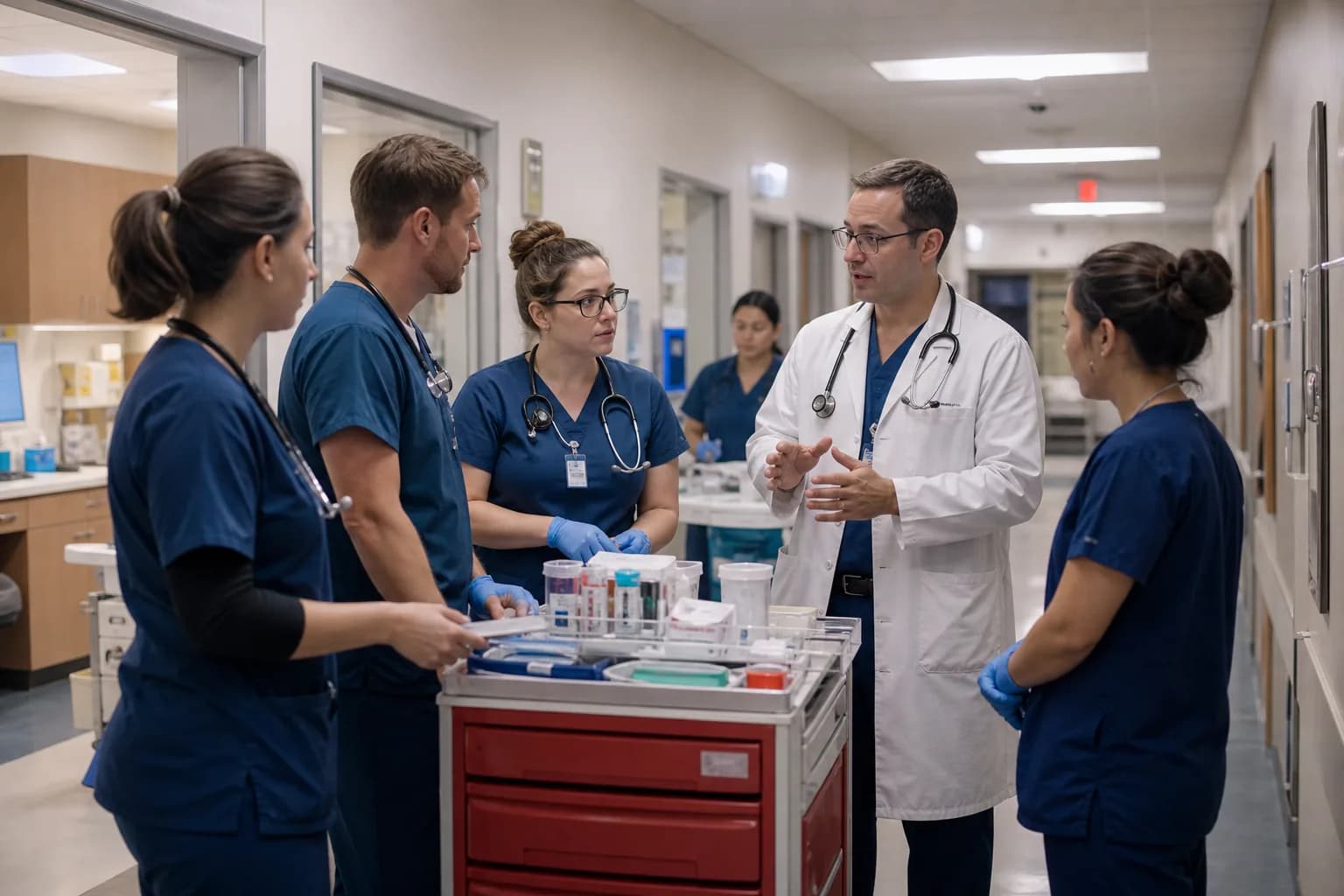
Document for each surge area before you need it
- Realistic conversion time, measured in a drill
- Equipment required and its current storage location
- Oxygen, suction and power capacity of the space
- Staffing ratio achievable and sustainable duration
- Named role responsible for initiating conversion
- How patients currently in the area are relocated
Triage tagging categories and who applies them
Disaster triage uses a different logic from everyday emergency triage, and the plan must say so explicitly, because staff trained only in routine triage will apply routine priorities under mass casualty conditions. The widely used tagging scheme sorts casualties into immediate, delayed, minor or ambulatory, and expectant or deceased, usually with red, yellow, green and black tags respectively. Which specific triage method your hospital adopts is a decision for your clinical committee, taken from a recognised source and trained accordingly.
The tag is a physical artefact and needs to be treated as one. Tags must be pre-positioned in adequate numbers where triage will occur, be weatherproof enough for outdoor use, carry a unique pre-printed serial number, and have a tear-off or retained portion so a record persists if the tag is lost. Buying tags and storing them in the administrator's cupboard is a common and self-defeating pattern; they must be in the disaster trolley, and the trolley must be checked on the same schedule as any other emergency equipment.
Name who triages and give them nothing else to do. A senior clinician performing triage must not also be treating, because the moment they begin a procedure the sorting stops and casualties queue unassessed. Retriage is equally important: a casualty's category can change while waiting, so the plan needs a defined re-assessment interval and someone responsible for it in each holding area.
Temporary registration when identity is unknown
Registration is where mass casualty response most often breaks, because normal registration assumes identity, time and a cooperative patient — and a mass casualty incident supplies none of them. The plan needs a pre-defined temporary identity scheme: a block of pre-generated unique identifiers, pre-printed on wristbands and label sheets, ready to be issued in sequence without anyone typing anything. Generating identifiers on the fly under pressure produces duplicates, and duplicates are extremely difficult to unpick later.
Every temporary identifier must be capable of being merged with a real patient record once identity is established, without losing any of the clinical events recorded against the temporary one. That is a system requirement to specify and test in advance, not something to discover on the day. HealUDoc can support provisional registration with a subsequent merge into the permanent record while preserving the full activity trail of what was recorded under the temporary identifier and when.
Attach the identifier to the person immediately and redundantly — wristband, tag and any belongings — because casualties move between areas quickly and a label on a chart that stays behind is worse than useless. Where possible, capture a photograph against the temporary record at the point of registration, subject to your own privacy governance, since it materially assists both reunification and the prevention of mix-ups when several unidentified patients are present simultaneously.
Staff call-in trees that work at 2 a.m.
A call-in tree fails in predictable ways: numbers are out of date, one person in the chain does not answer and the branch below them is never reached, and nobody knows who has actually been contacted. Fix the first by making contact-detail verification a periodic task with an owner, and audit it by sample-dialling rather than by asking staff to confirm. A tree validated only by staff self-declaration decays invisibly.
Design the tree so no single non-response can orphan a branch. Parallel notification through a group messaging system, with the phone tree as fallback, largely removes the problem, and the messaging system should record who acknowledged. What the coordinator needs is not the count of calls made but the list of who has confirmed they are coming and their expected arrival time, because that is what determines whether the second surge tier is viable.
Plan the reception of recalled staff as carefully as the call itself. Staff arriving into an unfamiliar situation need a defined reporting point, an assignment, identification, and a briefing — otherwise the response absorbs its own reinforcements. Include a rest and relief plan from the outset, because an incident lasting into a second shift with no relief roster is where errors concentrate.
“The drill taught us that thirty people arriving with no reporting point is worse than fifteen with one. We now brief at a single door and nobody enters the department without an assignment card.”
Tracking patients across improvised areas
Once casualties are distributed across a corridor, a converted day-care unit, a physiotherapy hall and the usual clinical areas, the hospital's biggest information risk is losing track of who is where. Every improvised area needs a designated tracker whose sole job is to maintain the list of identifiers present in that area and to record arrivals and departures. This is a low-skill, high-value role and is a good use of administrative staff who cannot contribute clinically.
Consolidate the area lists into a single incident board that the incident coordinator can see and that is updated on a fixed cycle. The board answers the questions that will be asked repeatedly and urgently: how many casualties are in the building, in which category, in which areas, and how many have been moved to theatre, ICU or another facility. HealUDoc bed and location tracking can serve as that consolidated view when the improvised areas have been pre-configured as locations, which is work worth doing before an incident rather than during one. Every transfer between areas must be recorded at both ends by both trackers.
Keep a paper fallback and rehearse it. Disaster conditions frequently coincide with power interruption, network failure or a system unavailable for the exact half hour it is most needed, and a digital tracking system with no manual equivalent is a single point of failure. The paper version should use the same fields and the same identifier scheme so reconciliation afterwards is mechanical rather than interpretive.
Reunification and the information desk
Families and media will arrive quickly and in numbers, and if there is no plan for them they will arrive in the emergency department itself. Designate a separate reception area away from clinical zones, staffed from the moment of activation, with a defined route by which enquiries are matched against the patient list. Reunification is a genuine operational function, not an afterthought, and it consumes staff who must be allocated in the plan rather than found on the day.
Set the information rules before the incident, not during it. Decide who is permitted to confirm a patient's presence and to whom, how identity of an enquirer is verified, what is never disclosed at a counter, and who is the single authorised spokesperson for media. Under the DPDP Act 2023 framework, disclosures of personal data require a lawful basis, and a well-meaning staff member confirming a name to a journalist is a data-protection incident as well as a communications failure.
Log every enquiry with its outcome. The log allows an enquirer to be traced when their casualty is subsequently identified, prevents families being asked the same questions repeatedly by different staff, and provides the record of what was disclosed to whom — which will matter in the review. Debrief the reunification function alongside the clinical response, because it is consistently the part of the plan that receives the least rehearsal and generates the most complaints.