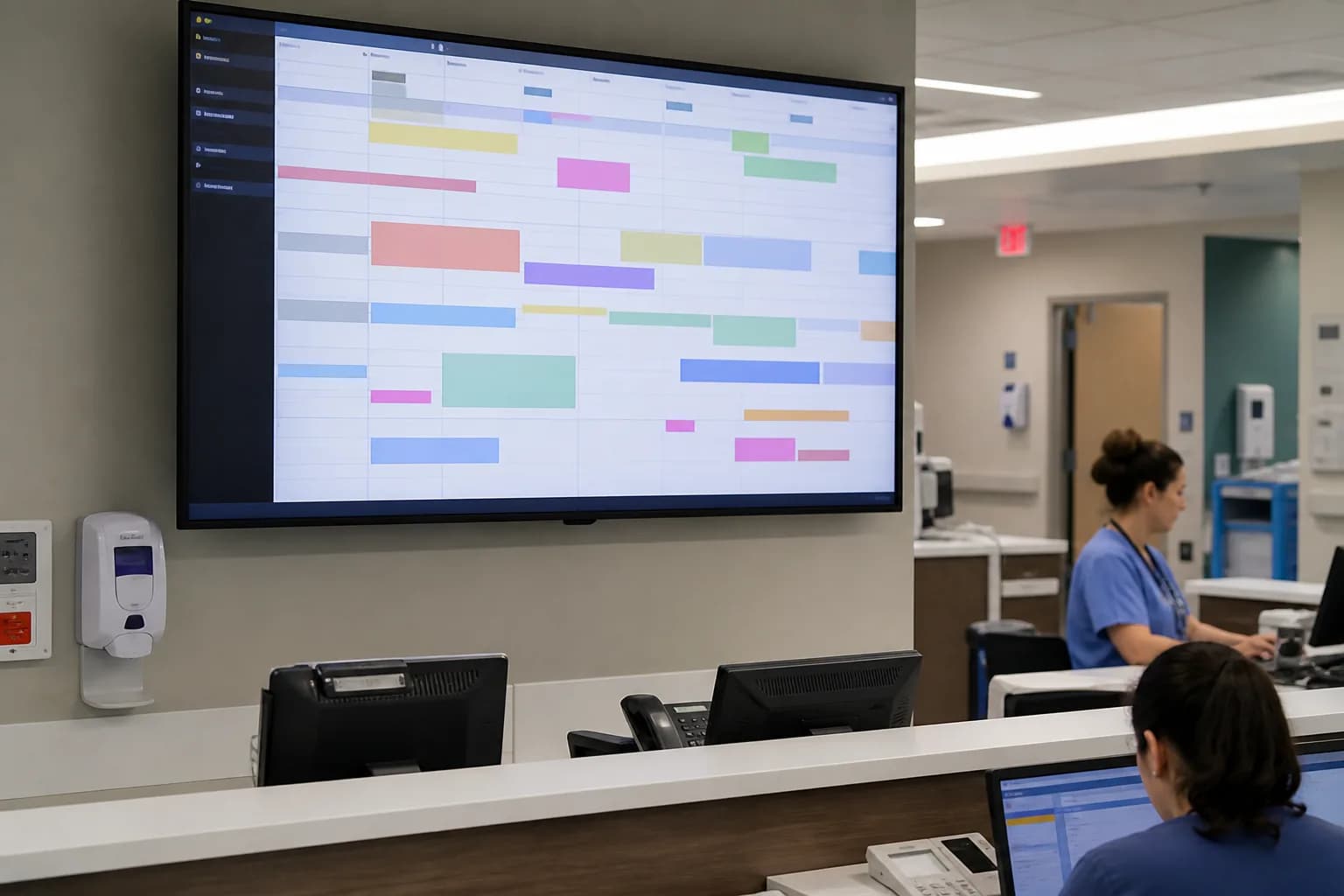
What a hospital token and queue display system has to solve
A hospital token and queue display system exists to answer one question for a waiting patient: am I still in this queue, and roughly how much longer? Everything else it does — call sequencing, counter allocation, announcement, analytics — is in service of that. Hospitals that lose sight of this build elaborate displays that show the current token number and nothing else, which tells a patient holding token 84 while 31 is showing exactly what they already feared and nothing they can act on.
The second thing it solves is the crowd at the door. Without a visible queue, patients manage their own uncertainty by standing as close to the consulting room as possible, which produces the corridor crush familiar to every OPD in the country. A display that is genuinely trusted lets people sit down, and the difference in the physical environment is immediate and obvious.
The third is the record. A token system generates a timestamped trail — token issued, called, served, skipped — that is the only reliable source of truth about how long people actually wait. Most hospitals never use this data, which is a shame, because it is far better evidence than the queue-length impressions that drive most waiting-area decisions.
Numbering schemes and what they leak
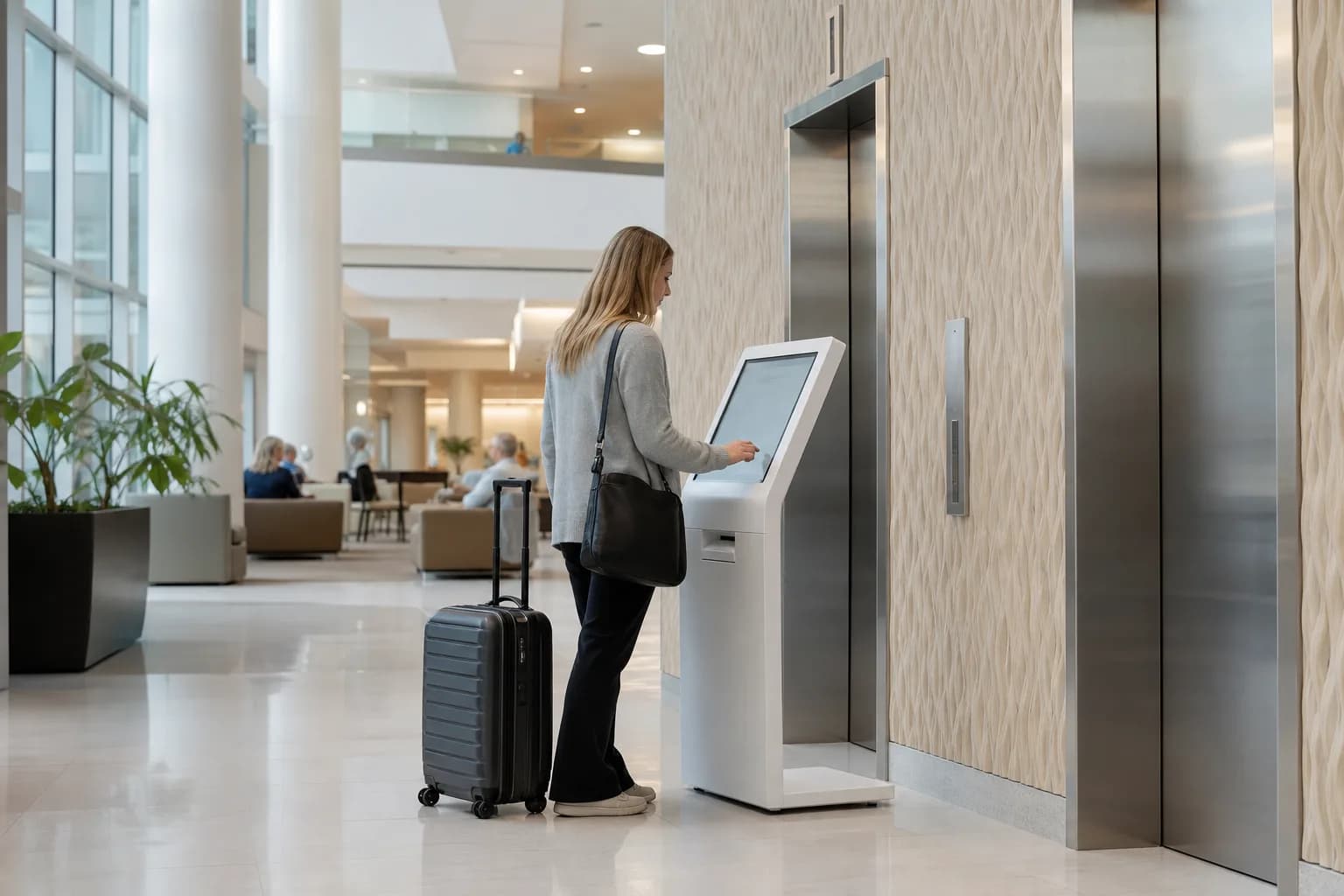
The simplest scheme is a single ascending series per day per service point, reset at midnight. It is easy to understand and easy to explain, and its main weakness is that the number itself carries no information about which queue it belongs to — a patient holding 47 in a hospital with six token-issuing points has to remember which 47 they hold. Prefixing by service point (R-47 for registration, C-47 for cardiology) fixes this at no cost.
Segmented schemes carry more information: a separate series per doctor, per counter, or per appointment type. These help patients but complicate the display, and they make the arithmetic of estimating a wait harder rather than easier because progress in one series says nothing about another. As a rule, segment only where the queues are genuinely independent — separate doctors in separate rooms, yes; three counters serving one common queue, no.
Be careful about what the numbering reveals. A scheme that visibly separates paying patients from scheme beneficiaries, or that gives a distinguishable prefix to a sensitive service, broadcasts something about the patient to everyone in the waiting area. Sensitive departments — psychiatry, HIV care, oncology, fertility, termination services — should not have a token prefix that identifies the department to a room full of people.
Numbering choices worth deciding deliberately
- Prefix by service point so a patient knows which queue their number belongs to
- Segment per doctor only where rooms and queues are genuinely independent
- Avoid prefixes that reveal payer category or a sensitive specialty
- Define the daily reset time and what happens to unserved tokens
- Decide whether re-issued tokens keep or lose their original position
Multi-counter registration versus multi-doctor consulting rooms
These are two different queueing problems and they deserve different designs. Multi-counter registration is a pooled queue: any counter can serve any patient, so a single series with a next-available call is both fairer and faster than dedicating a queue to each counter. The display needs to show token and counter together, because the patient's next action is to walk to a specific window.
Multi-doctor consulting is not pooled. Patients are attached to a specific doctor, so the queues are independent, and the display must show progress per doctor rather than a single running number. The design problem here is screen real estate: six doctors' queues on one board becomes unreadable at distance. Common solutions are per-room displays outside each door plus a summary board at the entrance, or a rotating board that cycles through doctors on a timer — the rotation being the weaker option, because a patient who looks up at the wrong moment has to wait for the cycle.
The hybrid case — a department where patients are pooled for vitals and triage, then split by doctor — needs the handoff to be visible. If a patient's token disappears from the triage queue and reappears in a doctor's queue with a new number, they will assume they have been lost. Carry the token identity across stages, or show the stage explicitly on the board.
Announcements, privacy and the DPDP question
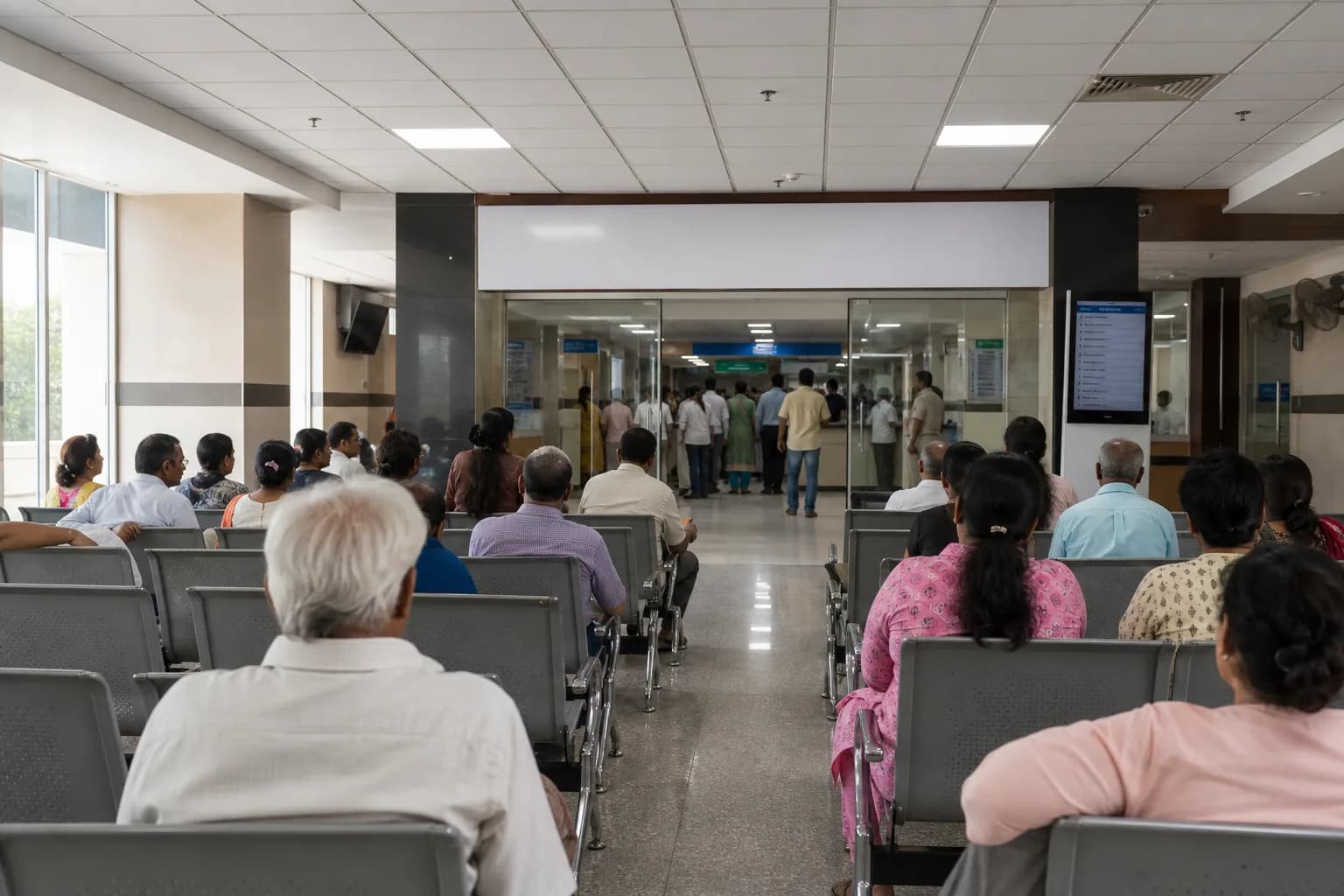
Audio announcement is the single most effective addition to a token system, because it reaches patients who are not looking at the board, who cannot read the board's language, or who cannot read at all. It is also the feature with the clearest privacy cost. Announcing a token number is fine; announcing a patient's name over a public address system in a crowded waiting area tells everyone present that this named person is attending this department today.
Under the DPDP Act framework, personal data should be processed for the purpose it was collected and no further, and a waiting-area announcement that discloses identity to bystanders is difficult to justify when a token number achieves the same operational result. The defensible default is token-only announcement, with names used only where the patient population makes numbers genuinely unworkable and the department is not sensitive. If names are used, the announcement should be limited to the first name or to a room-level display rather than a hospital-wide broadcast.
Language deserves as much attention as privacy. A display and announcement in the local language plus English will reach far more of the waiting population than English alone, and text-to-speech in regional languages is now good enough for token calls. Where literacy is a constraint, pairing the audio call with a large, high-contrast number and a clear directional indicator does more than any additional feature.
“We switched from calling names to calling token numbers and the complaints about the display stopped almost entirely. People had been objecting to being announced, not to waiting.”
Priority and emergency insertions without destroying trust
Every queue has legitimate exceptions: the deteriorating patient, the elderly or disabled patient with a statutory priority, the staff member's family, the referral that arrives mid-session with a time-critical question. The system will handle these; the question is whether the waiting room understands what happened. An insertion that is invisible reads as favouritism, and one visibly angry patient in a waiting area affects everyone in it.
The design answer is to make priority a visible category rather than a silent skip. If the display shows that the next call is a priority case, the queue understands that a rule was applied rather than a rule being broken. Statutory and courtesy priorities — senior citizens, persons with disabilities, pregnant patients — are widely accepted by waiting patients when they are declared as policy and applied consistently.
Clinical emergency insertions should bypass the display logic entirely, because a deteriorating patient should not be negotiated through a queue. What matters afterwards is that the interruption is recorded, so that a department with a high rate of emergency insertions is identified as a capacity problem rather than being absorbed silently by longer waits for everyone else. HealUDoc dashboards can separate priority and emergency insertions from routine calls, which turns an anecdote into a measurable pattern.
Insertion rules to publish and apply consistently
- Declared statutory and courtesy priorities, visible on the display
- Clinical emergency bypass, recorded but not queued
- A cap on courtesy insertions per session, with an accountable approver
- A defined rule for patients returning after being skipped
- Periodic reporting of insertion volume by department and reason
Hardware, failure modes and the manual fallback
Token systems fail in mundane ways: a display loses power, a network switch in the OPD block drops, a thermal printer runs out of paper at nine in the morning, or the counter application freezes with fifty people waiting. Each of these will happen, and the difference between a minor inconvenience and a chaotic morning is whether the fallback was decided in advance. Pre-printed token books at every issuing point, a laminated card explaining the manual sequence, and a named person who can authorise the switch are unglamorous and effective.
Design for graceful degradation. If the network drops, the counter application should keep issuing and calling tokens locally and reconcile when connectivity returns, rather than blocking entirely. If a display dies, the audio call should continue. If audio fails, the display should continue. Systems where every component depends on every other component fail completely rather than partially.
Placement is a hardware decision that gets made badly more often than any software decision. A display mounted above a doorway is invisible to anyone standing in the doorway; a screen facing a window is unreadable for four hours a day; a board at the far end of a long hall is useless at the size most vendors ship. Walk the waiting area at the hour it is fullest and check sightlines from the seats people actually use, not from the middle of an empty room.

Measuring the queue rather than admiring the display
The token system's timestamps let you measure things hospitals usually only guess at: time from token issue to first call, time from call to service start, the rate of skipped and re-called tokens, and the distribution of waits rather than the average. The distribution matters most — a department with a twenty-minute average wait and a ninetieth percentile of two hours has a serious problem that the average completely conceals.
Skip rate is an underused indicator. A high rate of tokens called and not answered usually means the announcement is not reaching people, that patients have left the area, or that the queue is moving unpredictably enough that people gave up. Before adding more displays, check whether the ones you have are being heard and seen.
Finally, connect queue data back to slot configuration. If a clinic's waits are growing steadily through the session, that is a scheduling problem showing up in the waiting area, and no amount of queue-display improvement will fix it. The token system is excellent at telling you where the pressure is; the fix usually lives upstream in how the session was built.