
Know Which Constraint You Are Actually Hitting
Growth pressure feels identical regardless of its cause, so diagnose before investing. A hospital short of consultation rooms will gain nothing from more online booking. A hospital with spare capacity but a saturated telephone line has a channel problem. A hospital where each consultant runs a personal booking convention has a standardisation problem that opening a second site will multiply rather than dilute.
Spend two weeks measuring three things: unfilled slots per session, time from patient request to confirmed booking, and the share of appointments created outside the official system. If unfilled slots are high while requests wait, the constraint is coordination rather than capacity. If both are low and clinics still overrun, the constraint sits in template design. Each diagnosis leads to a different first move.

Stage One: Make the Schedule Legible Before Making It Bigger
Before adding volume, make the current schedule visible in one place. A hospital running a paper OPD register alongside two departmental spreadsheets and a consultant's personal diary cannot scale, because nobody can reliably answer what capacity exists tomorrow. Consolidation is unglamorous, and it is the precondition for everything else, since waitlists, reminders, and cross-site booking all assume a single inventory.
Move one department at a time and keep the old record readable during validation rather than deleting it. HealUDoc can hold clinician availability, visit types, rooms, and leave in one authoritative schedule while reception continues booking by telephone, which separates data consolidation from any change in how patients reach you. Change one variable at a time, because two simultaneous changes make failures impossible to attribute.

Stage one consolidation checklist
- One authoritative schedule per clinician
- Leave and procedure blocks recorded centrally
- Rooms and equipment as bookable resources
- Old registers retained read-only
- Booking outside the system stopped by agreement
Stage Two: Standardise Templates Across Departments
At small scale, every consultant can run their own conventions and the desk simply remembers them. That memory is the thing that breaks first. By the time a hospital has eight or ten clinicians across several specialties, a new receptionist cannot hold the exceptions, and errors cluster around whoever is least experienced working the busiest session of the week.
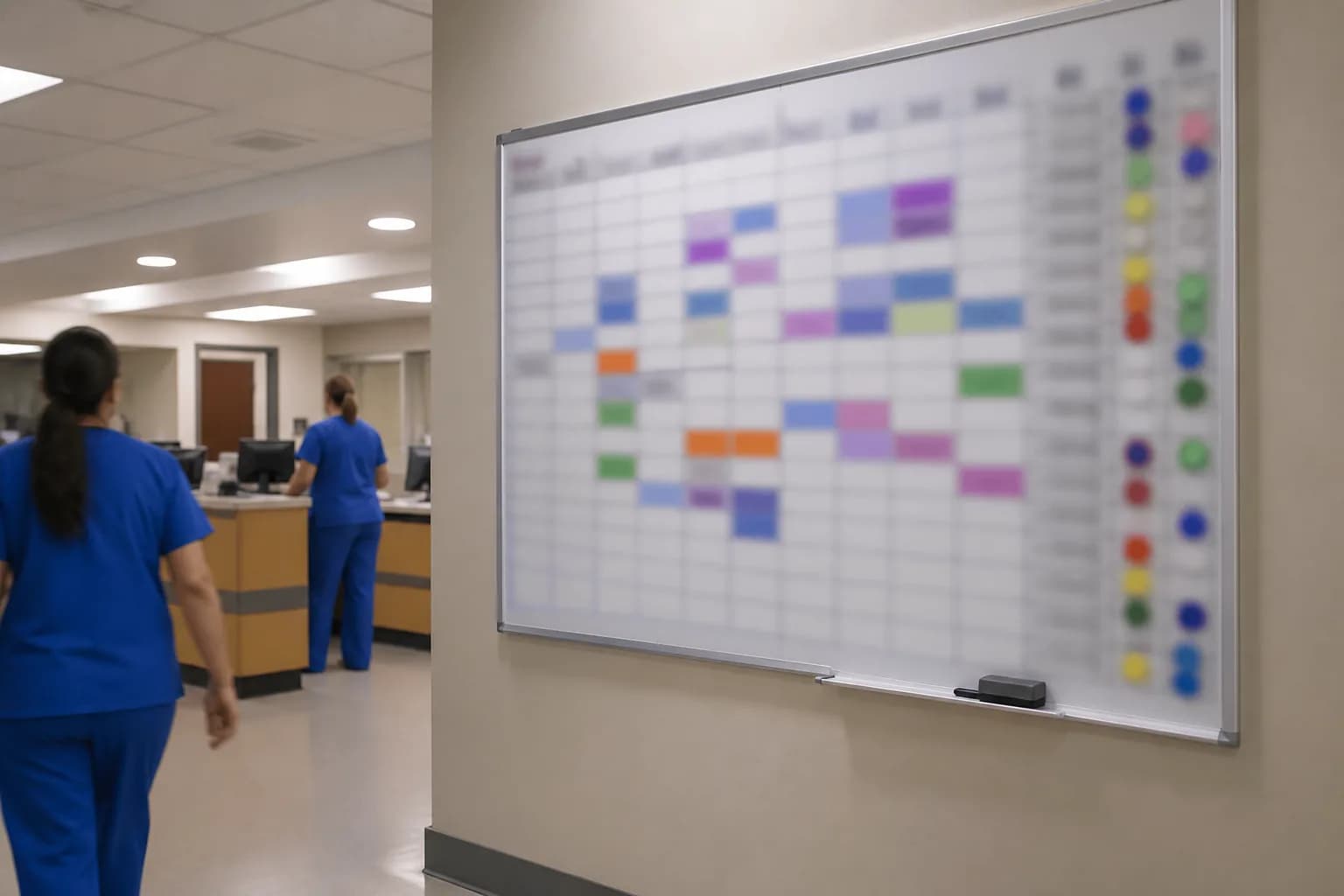
Standardise on a small library of visit types with defined durations, buffers, and eligibility rules, permitting specialty-level variation only where the clinical work genuinely differs. Review the library with clinicians using real consultation-length data rather than preference. Configured once in HealUDoc, these templates apply at every desk and every branch, which is what lets staff move between sites without relearning local habits.
Stage Three: Add Sites Without Fragmenting the Record
A second site is not a copy of the first. Patients move between branches, consultants rotate, and the same service may carry different prices, tax treatment, and room constraints. The characteristic failure is a patient whose records exist twice, once per site, so history, results, and outstanding balances stop following them. That damage is expensive to reverse and best prevented on the day the second site opens.
Keep one patient identity and one clinical record across sites while allowing branch-specific capacity, pricing, and staffing. HealUDoc's multi-branch model lets an authorised coordinator see availability across locations and offer an earlier slot at a nearby site without creating a second record. Add travel-time rules for rotating consultants so cross-branch sessions cannot be published back to back with no gap.

Multi-site scheduling decisions
- Single patient identity across branches
- Branch-specific pricing and tax rules
- Cross-branch booking authority
- Consultant travel-time constraints
- Per-site capacity reporting
Staff the Access Function Before It Becomes a Crisis
Growing hospitals usually add clinical staff to a plan and administrative staff in a panic. The access function, covering booking, rescheduling, waitlist management, reminder follow-up, and referral coordination, grows with volume whether or not anyone budgets for it. Left unstaffed, that work gets absorbed by the front desk during peak arrival hours, which is precisely when it is done worst.
Separate the roles as soon as volume allows: an arrival and check-in role that owns the queue, and a scheduling role that owns the future book and works away from the counter. Give the scheduling role the waitlist, the cancellation recovery queue, and the exception reports from HealUDoc. This single structural change tends to recover more usable capacity than any additional software feature.

Sequence, Review, and Know When to Stop
Sequence matters more than speed. Consolidate the schedule, standardise templates, then open channels such as portal booking and two-way reminders, and only then extend across sites. Reversing that order produces a hospital offering online booking against an inventory it does not control, which generates more exceptions at the desk than the new channel ever removes from the telephone line.
Set a review point after each stage using a small number of measures, such as unfilled capacity, time to booking, exception volume, and clinic overrun, and be willing to stop and stabilise rather than proceed on schedule. Scaling well is mostly the discipline of not starting the next stage while the last one still produces daily workarounds. Growth that outruns its operating model shows up in the waiting room long before it appears in a report.
“The month we stopped adding features and fixed our slot templates was the month our clinics started finishing on time.”