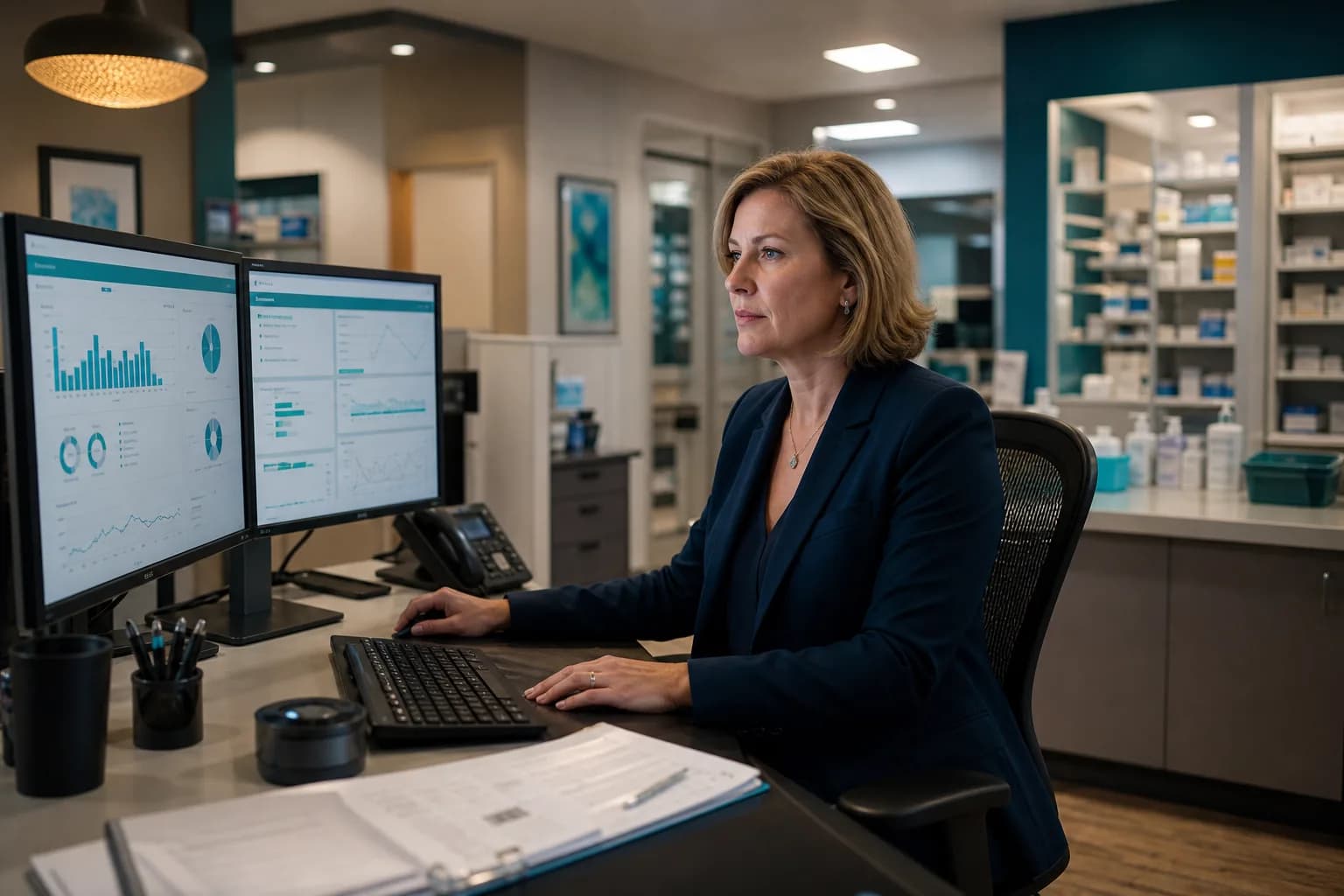
Separate platform metrics from care metrics
Availability, response time, and interface queue depth are infrastructure measures. They matter, because a chart that takes eight seconds to open changes clinician behavior in ways no policy will reverse, but they describe the system rather than the care. Presenting them to a clinical governance committee as evidence of EHR performance is a category error that hides workflow problems behind a healthy uptime figure.
Care metrics describe what the record enables: how quickly documentation becomes available to the next clinician, whether orders reach the right department, whether results are acknowledged. Keep the two sets in separate reports with separate owners. HealUDoc dashboards can present both, but the technical view belongs with the IT lead and the clinical view with the department heads who can actually change the workflow behind each number.

Documentation timeliness and completeness
The core measure is the interval between an encounter ending and its note being signed and available. Track it by specialty and by shift rather than as a hospital-wide average, because an OPD clinic and a night IPD admission have entirely different realistic targets. A median that looks acceptable often conceals a long tail of notes signed days later, and the tail is exactly where the continuity risk sits.
Pair timeliness with completeness measures that reflect clinical use: discharge summaries containing a reconciled medication list, operative notes recorded before the patient leaves recovery, admission notes with a documented problem list. Completion of a mandatory field is weak evidence, since a required box can be satisfied with a full stop. Where HealUDoc templates enforce structure, audit what clinicians actually entered rather than that they entered something.

Documentation measures worth tracking monthly
- Encounter-to-signature interval by specialty
- Unsigned notes older than seventy-two hours
- Discharge summaries completed before departure
- Problem list documented on admission
- Reconciled medication list at each transition
Order-to-result and acknowledgment cycles
Break the diagnostic cycle into segments you can act on: order placed to sample collected, collected to received in the laboratory, received to result verified, verified to result seen by a clinician. A single turnaround figure tells you the cycle is slow without telling you where. Most hospitals find the delay concentrated in collection or acknowledgment rather than in analysis, which is the segment laboratories are usually blamed for.
Acknowledgment deserves its own measure because it is where results are lost. Count results unacknowledged beyond a defined window, segmented by abnormality and by whether the ordering clinician is still on duty. Because HealUDoc links orders, results, and role-based task routing, an unacknowledged critical result can be surfaced as an open item rather than discovered during an incident review months afterward.

Clinician burden is a metric, not a complaint
Time spent in the record is measurable and worth measuring, but the useful cuts are specific: documentation completed outside scheduled clinical hours, the number of steps in high-frequency workflows such as prescribing a common medication, and inbox volume per clinician per week. Aggregate time in system invites argument; the observation that a discharge medication workflow takes nineteen steps gives an informatics team something concrete to fix.
Inbox burden needs particular attention because it accumulates invisibly. Measure items routed to each clinician, the proportion requiring no action, and how much volume is generated by rules the hospital added itself. Reviewing HealUDoc notification and task-routing configuration against these numbers usually reveals a handful of rules producing most of the traffic, and retiring them improves attention to everything that remains.

Burden measures that lead to concrete fixes
- Documentation time outside scheduled hours
- Steps in the most frequent order workflows
- Weekly inbox items per clinician
- Share of notifications needing no action
- Override rate on interruptive alerts
Data quality is the metric everything else depends on
Every downstream measure inherits the quality of the underlying record. Track the proportion of active patients with a coded problem list, allergies recorded as coded entries rather than free text, the duplicate patient creation rate, and encounters closed without a diagnosis code. These are unglamorous numbers that determine whether decision support functions at all, and a reporting layer built over inconsistent data produces confident, wrong answers.
Assign each data-quality measure to the role that can change it: registration for duplicates, clinicians for problem lists, coding for encounter closure. Review them in the same meeting as the clinical metrics so the connection stays visible. HealUDoc activity logs make it possible to trace a quality problem back to a specific workflow and branch rather than issuing a general reminder that changes nothing.

Build a review rhythm people can sustain
A metric nobody discusses is administrative overhead. Choose a small set, perhaps eight to ten measures spanning documentation, orders, burden, and data quality, and review them monthly with the same group. Add a measure only by retiring one. Committees tracking forty indicators inspect none of them properly and reliably miss the shift that mattered. Depth beats coverage in clinical measurement.
Investigate direction and inflection rather than distance from a benchmark. A number moving steadily the wrong way is more informative than one sitting slightly below an externally set target. When something changes, go and watch the workflow before theorizing, because the explanation is usually specific and mundane: a rota change, a broken printer, a new template, a staff member who left.
“We deleted two thirds of our EHR report pack and started improving. The measures we kept were the ones somebody in the room could act on before the next meeting.”