
Find the constraint growth will hit first
Growth rarely stalls where leaders expect. A hospital adding twenty beds often discovers the binding constraint is evening housekeeping cover, or a single sterile services autoclave that cannot support additional theatre sessions. Map the support services behind each clinical expansion — cleaning, portering, reprocessing, biomedical, pharmacy dispensing — and establish which one saturates first before committing capital to the clinical side.
The diagnostic is straightforward when the data exists. Look at turnaround intervals by shift and ward rather than daily totals, because saturation appears at the edges of the day long before it shows up in an average. HealUDoc breaks these intervals down by shift and location, which usually identifies the pinch point faster and more cheaply than a commissioned capacity study.

Constraints to test before expanding
- Housekeeping coverage by shift
- Sterile services reprocessing capacity
- Recovery and step-down bed availability
- Portering response at peak discharge hours
- Biomedical support for added equipment
Standardise the few things that must not diverge
Small hospitals succeed on flexibility, and the instinct when scaling is to preserve it everywhere. That is a mistake for a narrow set of things: patient identity, the service catalogue, bed and location naming, medication master data, and the role matrix. Divergence in these is cheap to allow and expensive to unwind, because every report and every interface downstream inherits the inconsistency permanently.
Everything else can stay local without harm — appointment templates, ward routines, local price lists, escalation contacts. Write down which category each decision belongs to and who may change it. HealUDoc separates enterprise-level master data from branch-level configuration, but the classification itself is a governance decision the hospital has to make before the second site opens its doors.
Sequence the operational build
Sequence matters more than speed. Registration, admissions, and bed management should be stable before theatre scheduling is layered on top, because theatre depends on downstream bed availability to be meaningful at all. Equipment registry work can run in parallel since it involves different staff, and it benefits from starting early — physical verification of assets always takes longer than anyone estimates.
Give each phase an exit condition rather than a date. Admissions is ready when the bed board is trusted enough that the desk stops calling wards; theatre scheduling is ready when the published list survives the morning without informal renegotiation. HealUDoc's modules can be enabled independently, which makes it practical to hold a phase open until it has genuinely landed with the people using it.

A workable rollout sequence
- Registration and patient identity
- Admissions, transfers, and bed states
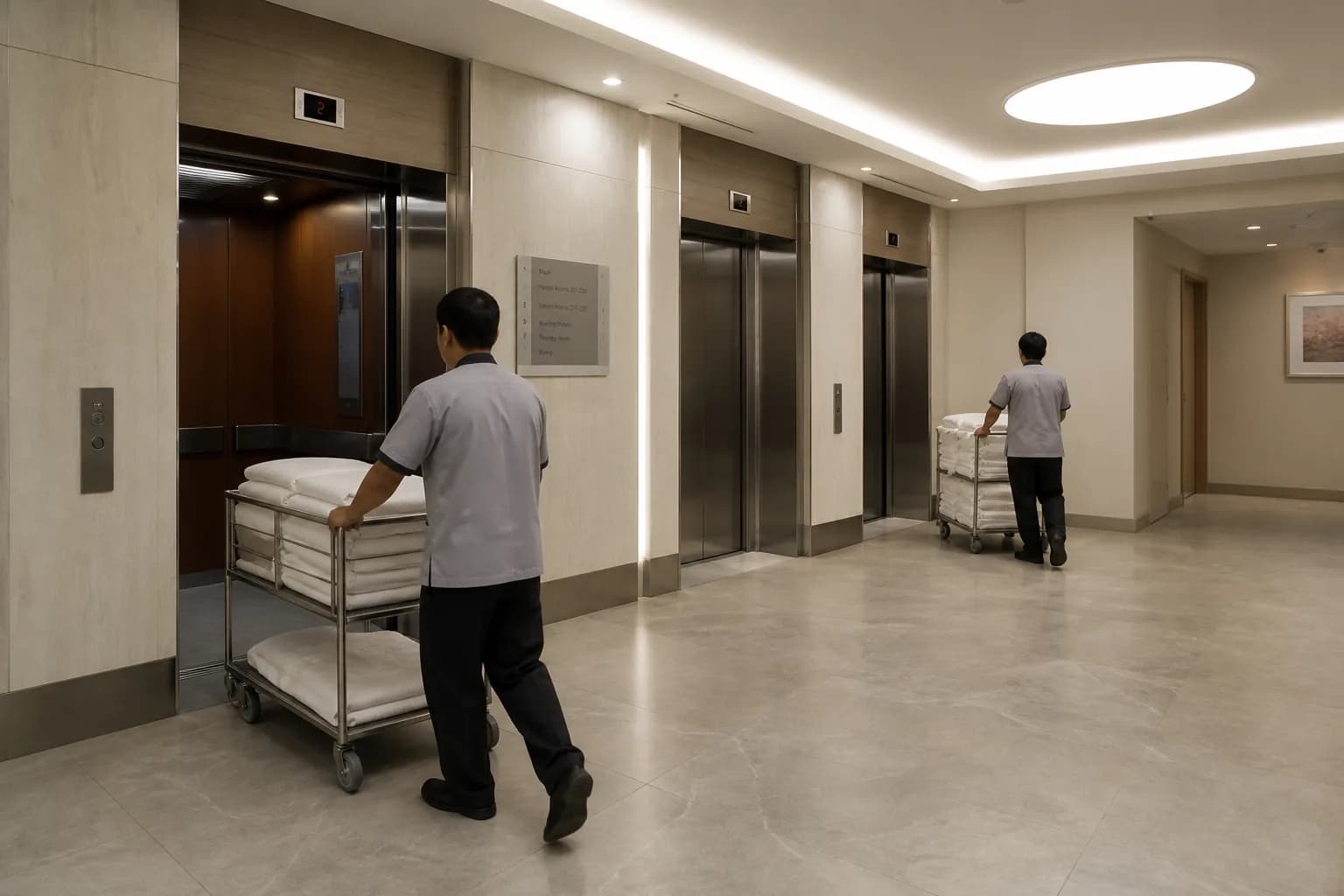
- Housekeeping and turnaround workflow
- Theatre scheduling and readiness checks
- Equipment registry and maintenance planning
Assign responsibilities you cannot yet staff
Mid-size hospitals often cannot justify a dedicated post for functions large hospitals staff fully: a bed manager, a perioperative coordinator, a biomedical planner. The workable pattern is to assign the responsibility rather than create the role. A senior nurse holds bed coordination for the shift, with authority to release reservations and escalate, and the duty rotates on a published roster everyone can see.
This only works when the system makes the responsibility executable by whoever holds it that day, so permissions have to follow the roster rather than the individual. HealUDoc supports time-bound role assignment, so the coordinating nurse gains bed release and override rights for the shift and loses them afterwards, with every action still attributable in the audit trail.

Opening a second and third site
The second site is where an operating model gets tested, and the common error is cloning the first site's configuration wholesale. A community hospital does not need the tertiary site's full theatre readiness workflow, and forcing it creates workarounds that later spread back to the original. Copy the standards, adapt the workflows, and record each deliberate difference with an owner and a review date.
Cross-site working needs its own design. Decide when a shared specialist gains access to a second branch's records, how a transfer carries clinical context and pending orders, and who arbitrates when both sites are full. HealUDoc's branch-aware roles handle the access mechanics cleanly; the escalation rule about who actually decides is a management agreement that must exist independently of the software.

Keep the operating model reviewable
Operating models decay quietly. A workaround adopted during a busy month becomes standard practice, an exception granted for one consultant becomes precedent, and within a year the documented process and the actual process have separated. Schedule a review that walks the real workflow with frontline staff rather than reading the configuration, because only the first method finds the drift.
Treat every recurring workaround as information rather than misconduct. If ward clerks are keeping a parallel bed list, the board is missing something they need, and finding out what is far more useful than instructing them to stop. Scaling well is mostly the discipline of noticing these signals early, while they still affect one ward rather than five.
“We grew from one hospital to four without a crisis because we treated every workaround as a design defect and went looking for the cause.”