
Baseline the current state before modelling any return
A credible return case starts with what the hospital already spends and loses. Pull twelve months of blood component discards, cancelled dialysis slots, ICU boarding hours in the emergency department, and overtime attributed to manual capacity coordination. Finance and critical-care leaders should agree on each definition before a single figure enters the model, because a discard counted one way by the blood bank and another way by finance will discredit the whole exercise at review.
Ledger entries alone understate operational cost. The interval between a transfusion request and blood bank acceptance, or between a triage assessment and a bed assignment, rarely appears in any account. Before implementation most hospitals need a short observation study, and a fortnight of shift-level tallies across the emergency department, ICU, and dialysis unit is usually enough to size the problem. Once HealUDoc is live, its activity logs replace that manual effort permanently.

Where critical-care costs actually accumulate
Four cost pools dominate most business cases: component wastage in the blood bank, unused capacity in dialysis and ICU, clinical and clerical time lost to coordination by telephone, and rework caused by incomplete requests that must be chased and resubmitted. Each behaves differently. Wastage is a direct consumable loss, idle capacity is forgone contribution, and coordination time is a labour cost that rarely appears as a line item anywhere in the accounts.
Separating these pools matters because they respond to different interventions. Expiry losses fall when inventory visibility and first-expire-first-out allocation improve, which is what HealUDoc's blood bank inventory views are built to support. Idle dialysis chairs need scheduling and readiness changes instead. Presenting one blended savings number invites the finance committee to challenge the weakest component and then dismiss the stronger ones alongside it.

Cost pools worth separating
- Expired and discarded blood components
- Unfilled dialysis and ICU capacity
- Coordination time spent on calls and chasing
- Rework from incomplete or rejected requests
- Duplicate testing after specimen or identity failures
Quantifying avoided waste in the blood bank
Blood component wastage is the most defensible savings line because units are individually identified and expiry dates are unambiguous. Start by classifying last year's discards into time expiry on the shelf, expiry while reserved for a patient who never received the unit, cold-chain excursions, and units returned unusable from wards. Only the first two categories respond well to better inventory software, and the case reads stronger for admitting that plainly.
Reservation expiry is often the largest recoverable share. Units held indefinitely for cancelled surgery age out while another ward orders fresh stock. HealUDoc tracks reservation validity alongside near-expiry status, so held units surface for release instead of quietly ageing. Model the saving conservatively by assuming recovery of part of the reservation and shelf-expiry categories rather than all of it, and state that assumption openly in the paper.
Labour and throughput effects worth counting
Coordination time is real money but easy to overstate. A charge nurse who saves fifteen minutes per shift does not become a headcount reduction, and finance directors know the difference. The honest claim is redirected clinical time or reduced overtime. Express the saving in hours by role and shift, describe what the released time is used for, and let the hospital decide whether it converts into cost reduction or additional capacity.
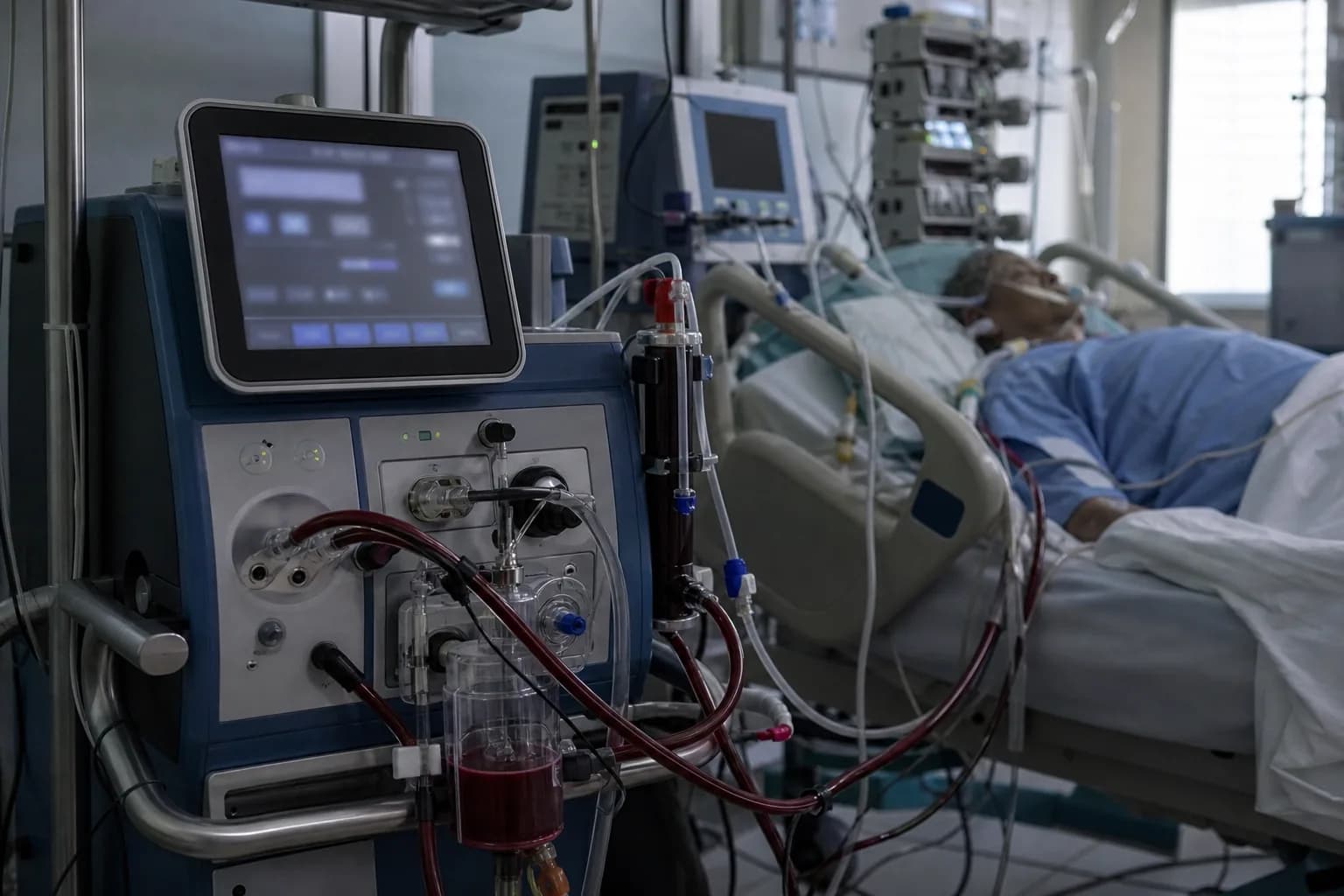
Throughput gains are more directly monetizable. Dialysis slots cancelled at short notice cannot be refilled without a managed waiting list, and each empty chair represents both a session's revenue and a patient's delayed treatment. HealUDoc's dialysis scheduling supports short-notice reallocation, which converts some cancellations into filled sessions. Faster ICU bed turnaround reduces emergency department boarding, although that benefit appears as avoided diversion rather than new income.
Throughput measures to model
- Late dialysis cancellations refilled from a waiting list
- ICU bed turnaround after the discharge decision
- Emergency department boarding hours
- Transfusion request-to-issue interval
- Repeat crossmatch samples avoided
Cost the project honestly, including the second year
Licensing is usually the smallest number in the total. Interface work to bedside monitors, dialysis machines, and laboratory analysers carries engineering cost on both sides of the connection. Migrating donor registries and standing dialysis prescriptions needs clinical validation time, not merely a script. Backfill for staff attending training is a genuine expense that hospitals routinely omit from the paper and then discover as overtime during the go-live month.
Second-year costs are where optimistic cases fail. Interface maintenance after monitor firmware updates, retraining for staff turnover in the ICU and emergency department, and governance time to review alert rules all recur annually. Budget for a period of parallel running in the blood bank, where the risk of losing traceability during cutover justifies deliberate duplication. A case showing three years of cost persuades far better than one showing twelve months.
Reviewing the case after go-live
Benefits realization dies quietly in most hospitals because nobody is asked to report on it. Assign each savings line an owner before approval, with the blood centre director accountable for wastage, the nephrology manager for slot utilization, and the ICU nurse manager for turnaround. Schedule a review at six and eighteen months. HealUDoc's dashboards can carry the same measures used in the original model, which removes any argument about whose numbers are correct.
Expect some lines to underperform and say so early. Wastage often falls faster than predicted while coordination savings arrive slowly, because habits such as confirming a request by telephone persist long after the workflow makes them unnecessary. Report variance with an explanation rather than revising the baseline retrospectively. A finance committee that trusts the reporting will fund the next phase; one that suspects revision will not.
“The business case that survived scrutiny was the one that named which savings we did not expect to achieve.”