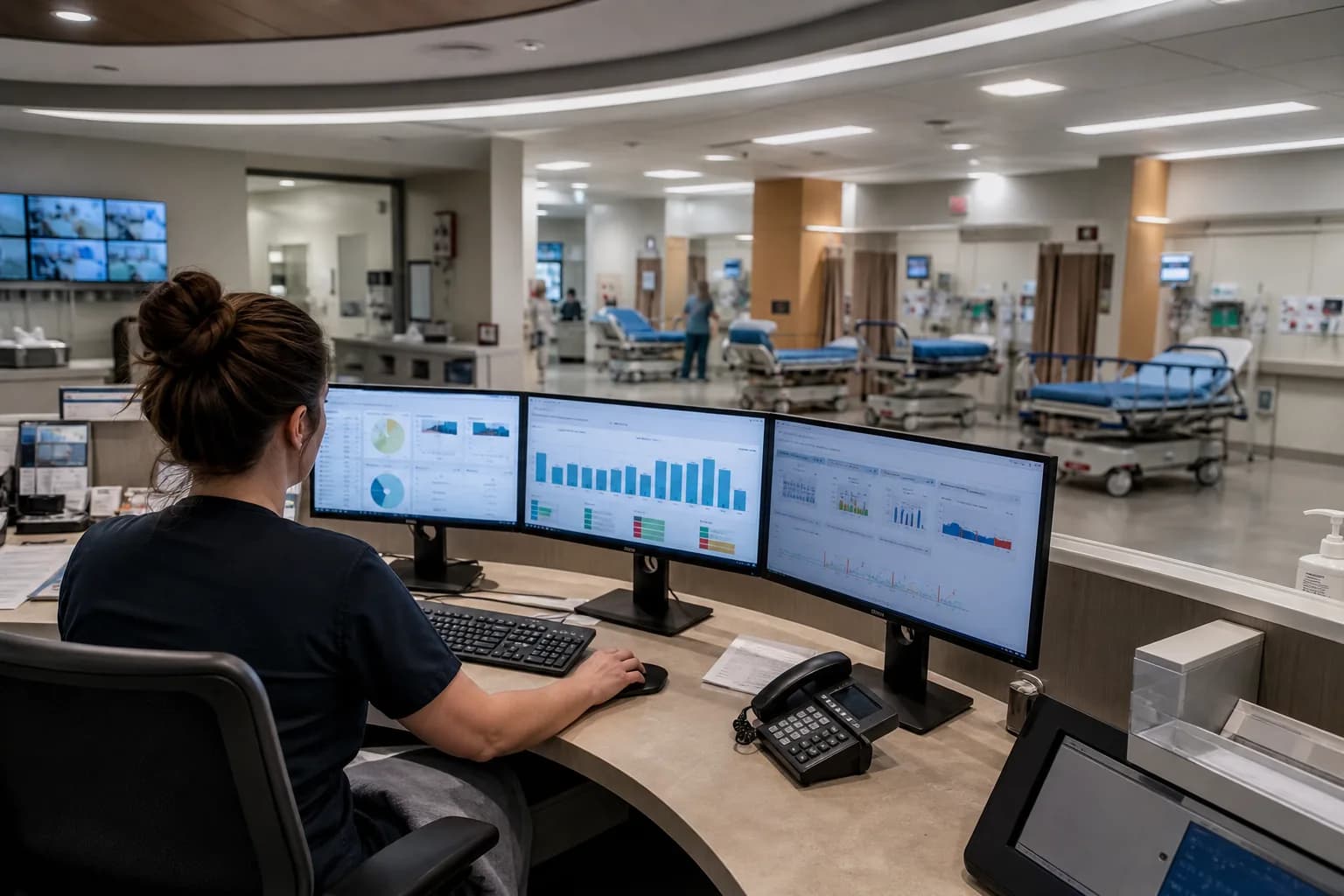
Start with the few reports the hospital cannot operate without
A hospital with sixty beds does not need forty dashboards. It needs four that are correct. In most facilities those are daily census and bed availability, OPD volume against clinic capacity, receivables and denials by payer, and a safety exception list covering unacknowledged critical results and pending discharge summaries. Everything else can wait until these four are trusted without discussion.
Publish them with a fixed refresh time, a named owner, and a visible last-updated stamp, then defend that list against additions for a full quarter. The constraint is deliberate. A small team can maintain definitions for four measures indefinitely, but a catalogue of forty will drift within months and take the credibility of the reliable four down with it.

The starting reporting set
- Daily census and available beds
- OPD volume against clinic capacity
- Receivables and denials by payer
- Safety exception queue
- Pharmacy stock-out and expiry alerts
Assign stewardship to existing roles rather than a new department
Small hospitals rarely justify a dedicated analytics team, and waiting for one is how reporting stays on spreadsheets for years. The workable pattern is distributed stewardship: the medical records officer owns encounter and coding definitions, the nursing superintendent owns census and safety exceptions, the finance manager owns revenue measures, and one administrator coordinates the calendar. Each holds a few protected hours weekly.
Stewardship means answering questions about a measure, approving changes to its definition, and reviewing its exception queue. It does not mean building reports. Because HealUDoc generates operational views directly from OPD, IPD, laboratory, pharmacy, and billing activity, stewards spend their time on definition and follow-up rather than assembling data, which is what makes a part-time model survive contact with a busy month.

Standardise definitions before the second site opens
Divergence is far cheaper to prevent than to repair. Once a second branch has run six months with its own admission status rules, locally invented service categories, and a different way of recording transfers, building the group view becomes a reconciliation project rather than a configuration task. The window to standardise closes quietly and nobody notices while it is happening.
Fix the shared layer first: service and department codes, encounter types, admission and discharge status transitions, payer categories, and period-assignment rules. Leave genuinely local things local, such as clinic naming or roster patterns. HealUDoc's branch-aware structure supports a common definition set with site-level views, so group comparison and local operational detail do not require two separate reporting builds.

Standardise across sites
- Service and department master codes
- Encounter and admission types
- Discharge and transfer status rules
- Payer and scheme categories
- Period-assignment and cut-off rules
Sequence the rollout by decision, not by module
Module-by-module rollouts feel orderly and deliver value late, because no single module answers a management question on its own. Sequencing by decision works better. To control receivables you need billing data, payer mapping, and the clinical documentation supporting the claim, so bring those three together and leave the remaining modules until the next cycle.
Choose decisions with a short feedback loop for the first phase, where the effect of acting on the report is visible within weeks. Receivables ageing, clinic no-shows, and pharmacy expiry all qualify. Long-horizon measures such as readmission or infection trends deserve attention later, once the organisation has built the habit of reviewing a number and recording what it did about it.

Let accreditation evidence fall out of daily work
Smaller hospitals feel accreditation preparation most acutely, because the same people who run operations also assemble the evidence. The unsustainable pattern is a three-month scramble before assessment, collecting registers and reconstructing records that should have been retrievable throughout. The work is real either way; the question is whether it happens once a year in panic or continuously as a by-product.
Map each NABH chapter requirement to a live record rather than a folder: equipment calibration to the maintenance log, medication safety to the pharmacy exception queue, credentialing to the workforce record, patient rights to consent capture. HealUDoc's compliance tooling and activity trail let a quality lead demonstrate that a control actually operated on a given date, which is what an assessor asks and what a screenshot cannot show.

Recognise when the model has been outgrown
The part-time stewardship model has clear limits. Signals that you have reached them include stewards missing definition reviews for two consecutive cycles, requests queuing longer than a month, branch figures needing manual adjustment before group consolidation, and the same reconciliation being performed by hand at every close. None of these are failures. They are evidence of growth.
The right response is usually one dedicated analyst plus stronger governance, not a wholesale platform change. Before adding tools, retire unused reports, confirm that definitions still match how services actually run, and check that HealUDoc's role and branch scopes reflect the current organisation chart. Most scaling problems at this stage are governance debt rather than genuine capability gaps.
“We grew from one hospital to four without an analytics department. What we did have was four measures nobody argued about.”