Three layers, one workflow: the short answer
A RIS manages the radiology process. A PACS manages the pixels. Your HMS radiology module manages the hospital's transactional view of imaging, which is mostly ordering, billing and report delivery. These are three different jobs that happen to touch the same patient at the same time, which is why they are so easily confused in a procurement discussion where everyone uses the word radiology to mean whatever their own system does.
The overlap is genuine and it is growing. Modern PACS products ship with worklists and reporting, so they look like a RIS. HMS radiology modules have grown order entry, scheduling and structured reporting, so they look like a RIS too. A small hospital can therefore run a credible radiology operation on an HMS module plus a viewer, while a tertiary centre with cross-site reporting and a subspecialty rota usually cannot. Both statements are true, and the interesting question is where the line falls for you.
This article is about the buying decision rather than the technical build. If you have already decided on separate systems and need to make them talk, the message flow itself is a different subject with its own failure modes. Here the question is narrower: given that your HMS already includes a radiology module you have paid for, under what conditions do you still need a standalone RIS, a standalone PACS, or both.
What a RIS actually does that a billing module does not
A Radiology Information System is a workflow engine for a department that has to move a study through a sequence of states with different people responsible at each one. Order received, protocolled, scheduled, patient arrived, prepared, acquired, technologist quality check, assigned to a radiologist, drafted, reviewed if a trainee drafted it, signed, delivered, and possibly amended. A billing-centric module typically knows two of those states, which are ordered and completed, because those are the two that produce a charge.
The states matter because they are where the department's problems live. A study sitting unprotocolled for three hours is invisible if your system only distinguishes ordered from completed. So is a study acquired at ten in the morning and still unassigned at six in the evening. A RIS also handles the things that are specific to imaging rather than generic to hospital orders: protocol selection driven by clinical indication, contrast administration records, radiation dose capture, technologist repeat and reject logging, and peer review sampling.
The honest counterweight is that a good deal of RIS functionality is unused in many Indian hospitals. Subspecialty assignment rules, complex resident and attending workflows, formal peer review programmes and academic teaching file management are all real features that a hundred-bed hospital with two visiting radiologists will never switch on. Paying for a full RIS and using its worklist and nothing else is a common and expensive outcome.
RIS capabilities that a generic order-and-bill module rarely has
- Protocolling as a distinct step with its own queue and owner
- Technologist repeat and reject logging by cause and by machine
- Contrast and radiation dose recorded against the study
- Radiologist assignment by subspecialty, priority and availability
- Structured amendment and addendum handling after a report is signed
What PACS is for, and where its boundaries sit
PACS exists to receive, store, retrieve and display images. Its native language is DICOM, its core competence is the reliable custody of very large objects, and its hardest problems are storage, retrieval speed and viewer performance on a slow network. A hospital that has a PACS has solved the question of where a CT from three years ago physically lives and how a clinician in the ward sees it without walking to the department.
The boundary confusion arises because PACS vendors added a worklist and a reporting screen, and because DICOM itself carries a Modality Worklist service that looks like scheduling. In practice PACS-native worklists are driven by what the modality sent, so they know about studies that exist rather than about orders that were placed. A study cancelled before acquisition, a patient who never arrived, and an order waiting for protocolling are all invisible to a worklist built from image arrivals.
The other boundary is non-DICOM content. Ultrasound units that produce only printed images, older endoscopy stacks, external CDs brought by patients, and scanned outside reports all sit awkwardly against a pure PACS. Most hospitals end up with a documented route for each of these, usually involving DICOM encapsulation or a linked document store, and the route is worth deciding deliberately rather than letting each department improvise its own.
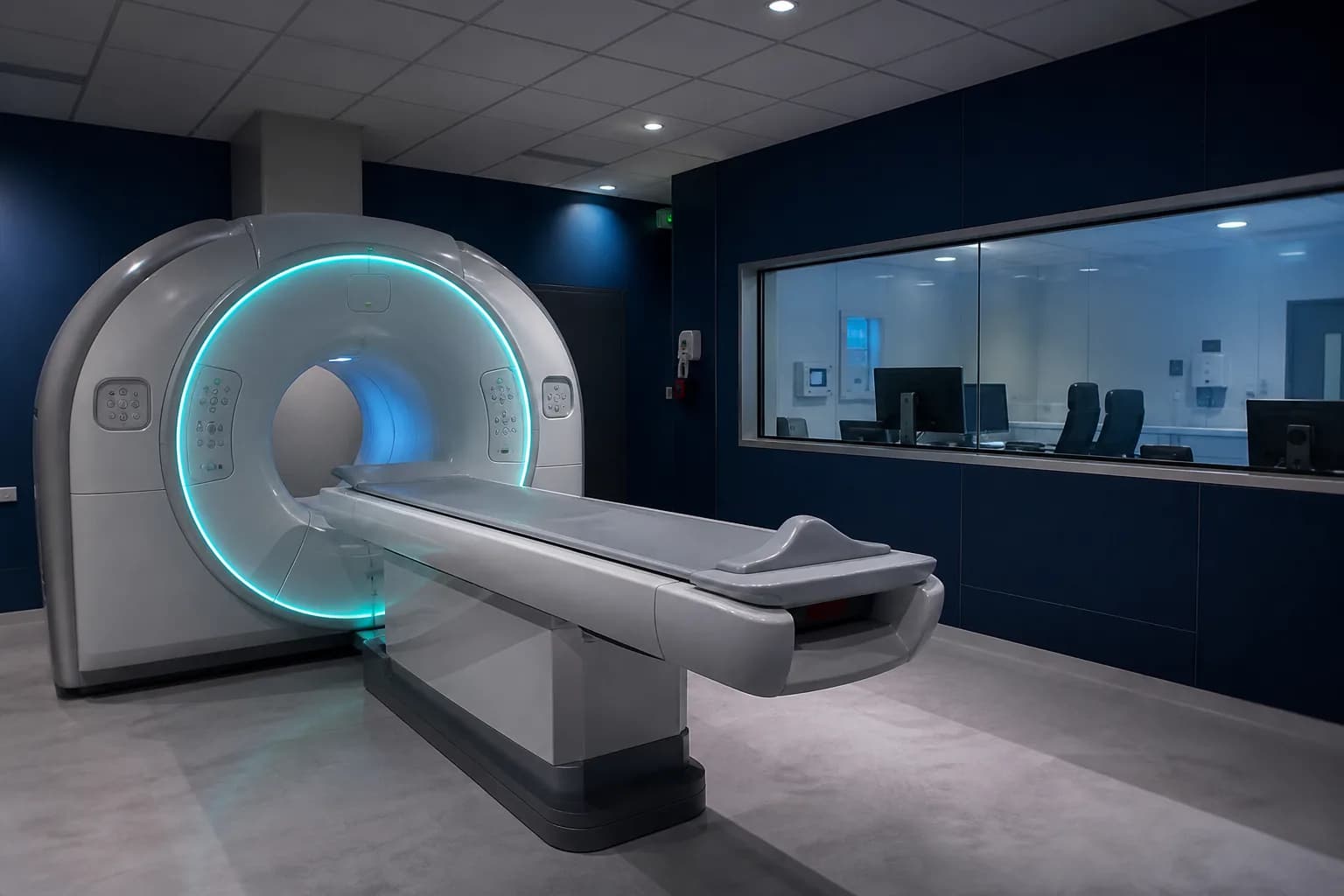
What your HMS radiology module already covers
The radiology module inside a hospital management system generally does order entry from the OPD and IPD screens, a service and rate catalogue tied to your billing, a scheduling capability of some depth, patient demographics that are already correct because they came from registration, a report entry screen with templates, and delivery of the finished report to the patient portal and the referring clinician. That is a substantial share of a small or mid-sized department's actual daily work.
It also carries an advantage that standalone products cannot match on their own: it already knows the patient. There is no duplicate patient index to reconcile, no separate identifier to map, no risk that the demographic correction made at the front desk fails to propagate. In a hospital where the master patient index is the thing most likely to break, keeping radiology inside it removes an entire class of problem before it starts.
Where these modules are typically thin is in the department-internal states described earlier, in modality-specific data such as dose and contrast, and in reporting ergonomics for a high-volume radiologist. A consultant reading eighty studies in a session cares intensely about how fast the previous study loads next to the current one and how few clicks a sign-off takes. A module designed primarily around the hospital transaction rarely wins that comparison without deliberate investment.
Questions that expose whether your HMS module is genuinely sufficient
- Can you see how long a study waited between acquisition and assignment
- Can a radiologist read prior and current studies side by side without leaving the report screen
- Are contrast reactions and dose values recorded against the study or only in a paper register
- Can you route a study to a specific radiologist by subspecialty and priority
- Does an addendum after sign-off preserve the original report as a distinct version
The decision: when the HMS module is enough
For a hospital running plain radiography, ultrasound and a single CT, with two or three radiologists who read on site and a report volume in the low hundreds per day, an HMS radiology module plus a competent PACS is usually the right answer. You get one patient index, one bill, one report delivery path, and images handled by a system built for images. Adding a third product into that shape buys workflow features the department will not use and an interface you now have to maintain.
The picture changes when any of four things become true. Multiple sites reading each other's studies, so allocation and turnaround become a management problem rather than a rota. A subspecialty structure where a study must reach a particular reader. A teaching setup with trainee drafting and consultant sign-off. Or an outsourced teleradiology arrangement that needs studies pushed and reports returned against contractual turnaround times. Each of those pushes real complexity into the process layer, which is exactly what a RIS is built for.
There is also a legitimate middle path that gets overlooked: pressing your HMS vendor to extend the radiology module against a written specification, rather than buying a third system. It works when the gaps are a handful of specific states and fields. It fails when the gap is reporting ergonomics, because that is a product design problem and not a feature list. Be honest about which of the two you have before signing anything.
“We ran the comparison and found that the only RIS features we would actually switch on were the protocolling queue and dose capture. Our HMS vendor built both in a quarter for a fraction of a new licence.”
What nobody tells you about running three systems
Every additional system adds an interface, and every interface adds a category of incident that nobody owns. When an order placed in the HMS does not appear on the modality worklist, the HMS vendor says the message was sent, the RIS vendor says the field was malformed, and the PACS vendor says the study never arrived. Meanwhile a patient is on the table. Hospitals that run multi-vendor imaging estates well do one specific thing: they insist on a single integration owner, whether internal or contracted, whose job is the chain rather than any one box.
The cost picture is also wider than the licence quote. Add annual maintenance on three contracts, a test environment for each, separate user administration unless you have single sign-on, and the internal effort of reconciling master data such as the service catalogue, which now exists in more than one place and will drift. Rate changes are the classic symptom: a price updated in the HMS and not in the RIS produces a report that is delivered and a charge that is wrong.
None of this argues against multi-vendor architecture, which is often the right choice for a large department. It argues for costing it truthfully. If the business case for a standalone RIS assumes the same support overhead as your current single-vendor arrangement, it is understated, and the difference will appear as unplanned IT effort rather than as a line in the budget.

A decision sequence you can run in a fortnight
Start by writing down your department's actual workflow states on a whiteboard with the person responsible for each one. Then, for each state, mark whether your current system can show you how many studies are sitting in it right now. The states you cannot see are your real gap, and they are usually fewer than a vendor demonstration suggests. This exercise takes an afternoon and reframes the entire conversation away from feature grids.
Next, measure. Pull a month of studies and calculate the time between acquisition and report signature, split by modality and by priority. If the distribution is tight and acceptable, your process is working and a new system will not improve it. If it has a long tail, find out which state the tail is sitting in before you buy anything, because a RIS that speeds up assignment will not help a department whose delay is actually a radiologist availability problem.
Finally, run the shortlist against your own worst week rather than a demonstration dataset. Ask each vendor to show a stat study jumping the queue, an addendum after sign-off, a patient merged after a wrong registration, and a study reported by an external teleradiologist. Those four scenarios separate products more reliably than any feature comparison, and they are the ones your department will live with every day.