
Why generic appraisal formats fail on clinical work
Performance appraisal for hospital clinical staff usually runs on a form borrowed from general corporate practice: a set of rating scales, a manager's comment, and a score that feeds an increment decision. It fails in a hospital for a structural reason. Clinical performance has at least three independent dimensions — the quality and safety of care, professional behaviour and teamwork, and productivity — and a good performer on one can be a poor performer on another.
Collapsing them into a single number destroys the information. A consultant with the highest case volume in the department and a pattern of dismissing nursing concerns scores well and represents a genuine safety risk. A nurse with modest throughput who catches deteriorating patients early scores poorly against anything the form measures. Both outcomes are the format's fault, not the appraiser's.
The design fix is to rate the dimensions separately and to resist the urge to average them. Three visible scores force an honest conversation about a specific weakness rather than allowing a strength to conceal it.
Separating quality, behaviour, and productivity
Quality and safety covers protocol adherence, documentation completeness, participation in audit and mortality review, incident involvement in context, and outcomes where they can be fairly attributed. It is the hardest dimension to measure and the most important, which is why it is usually the one omitted.
Professional behaviour covers teamwork, communication with patients and families, responsiveness to nursing and junior staff, handover discipline, and conduct under pressure. It is dismissed as soft and is in fact the dimension most predictive of team-level safety, because it determines whether a junior nurse will call at 3 a.m. when something looks wrong.
Productivity covers volume, throughput, and utilisation. It is the easiest to measure, which is precisely why it dominates by default. Its legitimate role is contextual — a consultant whose clinic runs at a fraction of its slots has something to explain — but as the primary basis of appraisal it actively distorts care.

Three dimensions, rated separately
- Quality and safety: protocol adherence, documentation, audit participation, outcomes in context
- Professional behaviour: teamwork, communication, responsiveness, conduct under pressure
- Productivity: volume, throughput, and utilisation, read with case mix in view
- Do not average the three into a single composite score
- Require a written justification for any rating at either extreme
Why volume-only metrics distort clinical care
When volume becomes the dominant appraisal metric, entirely rational individual responses produce collectively poor care. Consultations shorten. Complex or unprofitable patients are referred elsewhere. Documentation thins because it competes with throughput. Teaching and supervision of juniors, which produce no measurable output for the person doing them, get deprioritised.
The referral effect deserves particular attention. Any metric that penalises complexity creates pressure to avoid complex patients, and the doctors who accept the hardest cases end up with the worst numbers on both volume and outcomes. An appraisal system that does this is systematically penalising exactly the behaviour the hospital most needs.
This does not mean productivity is illegitimate. It means it must be read alongside case mix and quality, and that a productivity figure should prompt a question rather than deliver a verdict. Low volume with strong quality and heavy teaching contribution is a different situation from low volume with nothing else in evidence, and the appraisal should be able to tell them apart.
Peer input and multi-source feedback
A single manager cannot observe most of what matters in clinical performance. A department head sees a consultant in meetings and reviews their numbers; the people who know how that consultant behaves at 2 a.m. are the nurses, the residents, and the theatre team. Any appraisal that relies solely on the reporting line is working from a narrow and predictable slice.
Multi-source feedback addresses this by gathering structured input from peers, from staff who work under the individual, and where appropriate from patient experience data. Structure is what makes it usable — specific behavioural questions rather than open-ended impressions, enough respondents that no individual view dominates, and aggregation that protects respondents from identification.
It also carries real risks in a hospital's hierarchy. A junior nurse asked to rate a consultant who controls her ward assignment is in a difficult position, and if confidentiality is imperfect the exercise will produce uniformly positive and entirely useless results. Introduce it developmentally first, before it carries consequence, and be honest that this is the phase where the process earns or loses credibility.

“The first year we ran peer feedback, everyone scored well. The second year, once people saw nothing bad happened to them for being honest, we finally learned something.”
Calibration across departments
Appraisal ratings from different department heads are not comparable, and treating them as though they are is the fastest route to losing staff trust in the entire process. Some heads rate generously to protect their team's increments; some rate strictly on principle. A nurse in one department and an identically performing nurse in another receive different ratings for reasons that have nothing to do with either of them.
Calibration is the correction: department heads review their proposed ratings together, present the reasoning behind their outliers, and adjust for demonstrable systematic difference. It is uncomfortable and it works, because a head who must justify a top rating aloud to peers is more careful than one who submits it on a form.
Calibration is not the same as a forced distribution. Mandating a fixed percentage in each rating band assumes every team has the same performance spread, which is false, and it pits colleagues against each other in exactly the environment where teamwork matters most. Calibrate the standard, not the shape of the curve.
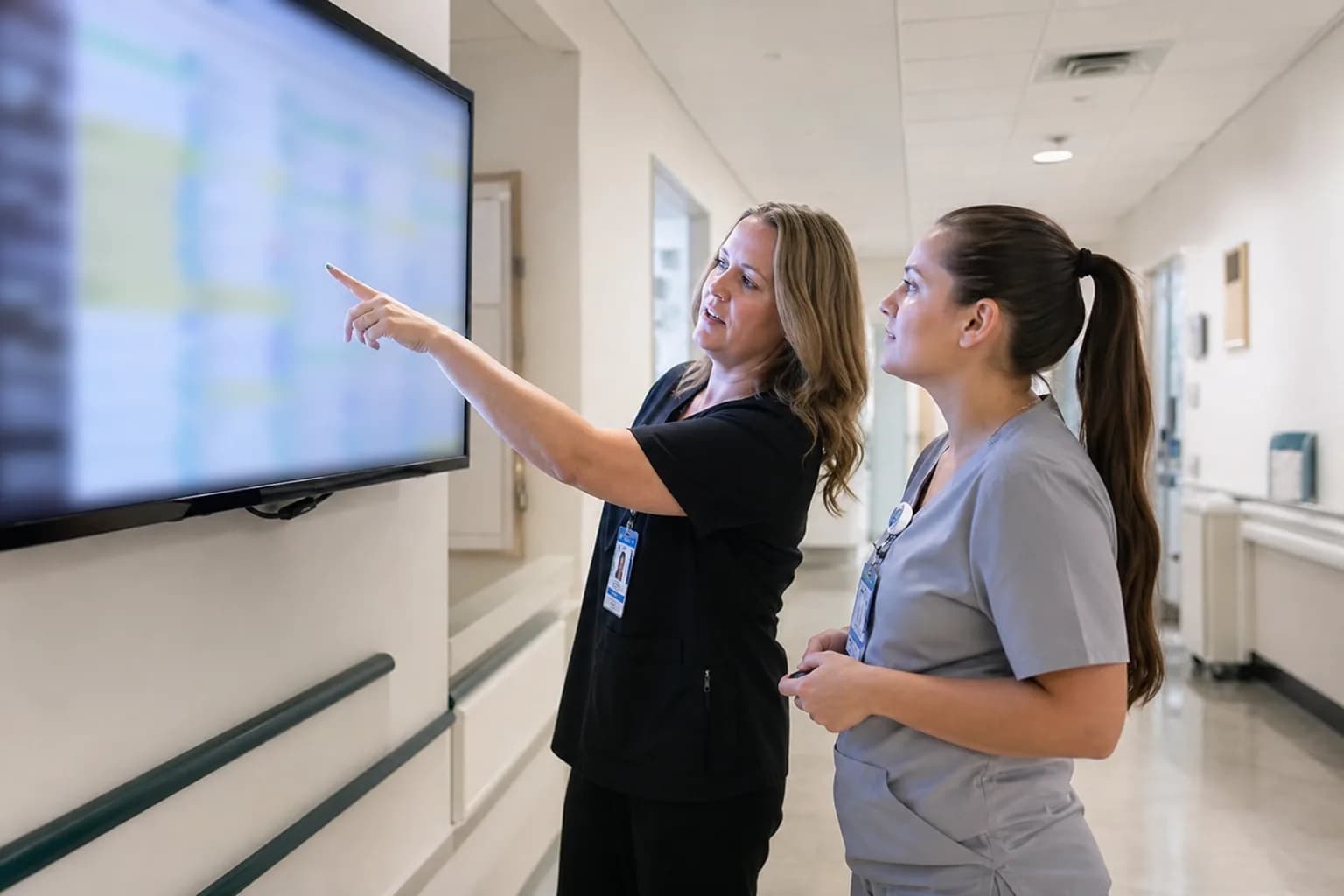
Running a calibration session well
- Department heads present outlier ratings with their reasoning, not the whole list
- Compare against a shared written standard for each rating level
- Adjust for systematic leniency or severity, not for individual preference
- Avoid forced distribution — calibrate the standard, not the curve
- Record the rationale for any rating changed in the session
Linking appraisal to development, not only to increment
When appraisal exists solely to determine increments, every participant behaves accordingly. The appraisee defends rather than reflects, the appraiser inflates to avoid conflict, and the developmental content becomes a paragraph written after the rating was decided. Nothing about the process improves anyone's practice.
Separating the developmental conversation from the increment conversation, in time and often in format, changes the incentives. A mid-cycle developmental review with no rating attached can be genuinely honest about a weakness. The year-end review then confirms rather than surprises, which is the single most reliable marker of a well-run appraisal system.
The output should be specific and resourced. A development plan naming a competency to acquire, the mechanism — a course, a proctored period, a rotation, a mentor — and a review date is useful. Improve communication with nursing staff is not. And the plan has to connect to the hospital's actual training calendar and competency framework, or it becomes a promise the organisation never keeps. Where development plans are recorded against the same staff profile that HealUDoc uses to track training and competency, the review date arrives as a prompt rather than as an item nobody revisits until the next appraisal.
Making the cycle sustainable and evidence-based
Appraisal quality collapses when everything happens in one week of the year and appraisers reconstruct twelve months from memory, which reliably means they recall the last six weeks. Continuous evidence capture fixes this: incidents, audit participation, training completion, patient feedback, and commendations recorded against the individual as they occur, so the appraisal starts from a file rather than a recollection.
This is the point at which the workforce system earns its place. HealUDoc can hold training records, competency validations, credentialing status, and attendance alongside the appraisal record, so the reviewer opens a populated history rather than a blank form. The judgement remains entirely human; what changes is that it is exercised on evidence.
Then audit the process itself. Look at rating distribution by department and by appraiser, the proportion of appraisals completed within the window, the share carrying a specific development plan, and whether those plans were actually executed. An appraisal system nobody evaluates will drift toward uniformly high ratings and empty development sections within about two cycles.