What a code blue and rapid response team workflow must guarantee
A code blue and rapid response team workflow has exactly one job: move a competent team, with the right equipment, to a deteriorating patient within a known and repeatable number of minutes. Every other element — the criteria card, the paging chain, the event record, the debrief — exists to protect that interval. Hospitals that treat this as a policy document rather than a rehearsed operational chain usually discover the gaps during a real event, at the worst possible moment. The design questions here are logistical and informational, not clinical.
A working system needs five things: published activation criteria any staff member can apply without permission, a single activation channel that cannot be missed, a named team with pre-assigned roles, a contemporaneous event record, and a stand-down routine that returns the area to readiness. Rapid response and code blue are two tiers of the same escalation ladder — one called on deterioration, one on arrest — and both should be reachable through the same number and the same mental model. If staff must first decide which of two systems applies, they hesitate, and hesitation is precisely the failure mode you are designing against.
The clinical content of the criteria belongs to your resuscitation committee and the guideline it has formally adopted. What operations and informatics teams own is everything around it: whether the criteria are visible at the bedside, whether the call reaches a live human, whether the team knows who is doing what on arrival, and whether the record can later be reconstructed. Keep that boundary clear when you write the SOP, because blurring it is how workflow documents quietly become unauthorised clinical guidance.
Activation criteria and who is permitted to call
The single most important design decision is that any staff member may activate without seeking approval from a senior. The moment a nurse must first find a duty doctor to authorise a rapid response call, you have inserted a search step into a time-critical path and made the escalation dependent on hierarchy. Write the permission explicitly into the policy, state it in induction, and make it clear that a call later judged unnecessary is never a disciplinary matter. A programme that punishes over-calling will very quickly stop receiving calls at all.
Alongside the physiological criteria your committee adopts, include a worried criterion — a clause allowing activation on staff or family concern even when no parameter has crossed a threshold. Experienced bedside nurses often recognise deterioration before it is measurable, and a criteria set that cannot accommodate that judgement discards your most sensitive detector. Families of long-stay patients notice change too, which is why some hospitals extend activation rights to attendants with a clearly explained route.
Criteria are only useful where the patient is. Print them on the observation chart, on the bedside monitor housing, and inside the ward station, not only in the policy manual on a shared drive. Where observations are charted digitally, a platform such as HealUDoc can surface the escalation prompt in the same screen where the vitals were just entered, so the criterion is applied at the moment of measurement rather than recalled from memory an hour later.
What the activation policy must state in plain language
- Any staff member may call, without seniority approval
- The single number or button used for every tier
- A concern-based clause independent of numeric thresholds
- That a call judged unnecessary carries no consequence
- Who may stand the team down, and when
- How the call is escalated if not acknowledged
Paging, announcement and the arrival problem
Most delays in a code response are not clinical; they are communication and navigation. The call must reach every responder simultaneously rather than travelling down a phone tree, and the announcement must carry an unambiguous location. Ward name alone is insufficient in a multi-block hospital where two buildings share ward numbering, so the standard announcement string should include block, floor, ward and bed in a fixed order that never varies.
Build a fallback path and test it. Overhead public address, group paging, and mobile push each fail differently: the PA is inaudible in some plant rooms, pagers run flat, and mobile notifications depend on coverage that is often worst in basements and lift lobbies. Running two independent channels in parallel is cheaper than investigating why one responder never heard the call. Whichever channels you use, log the activation timestamp automatically at the point of call rather than reconstructing it afterwards from memory.
Arrival is its own problem in older buildings. Responders coming from another block need lift priority, unlocked stairwell doors, and a route that does not pass through a badge-controlled corridor whose reader is slow. Walk the route at night with the actual on-call team before you sign off the plan, because the version drawn on a floor plan rarely survives contact with a locked fire door.
Team composition and the role card system
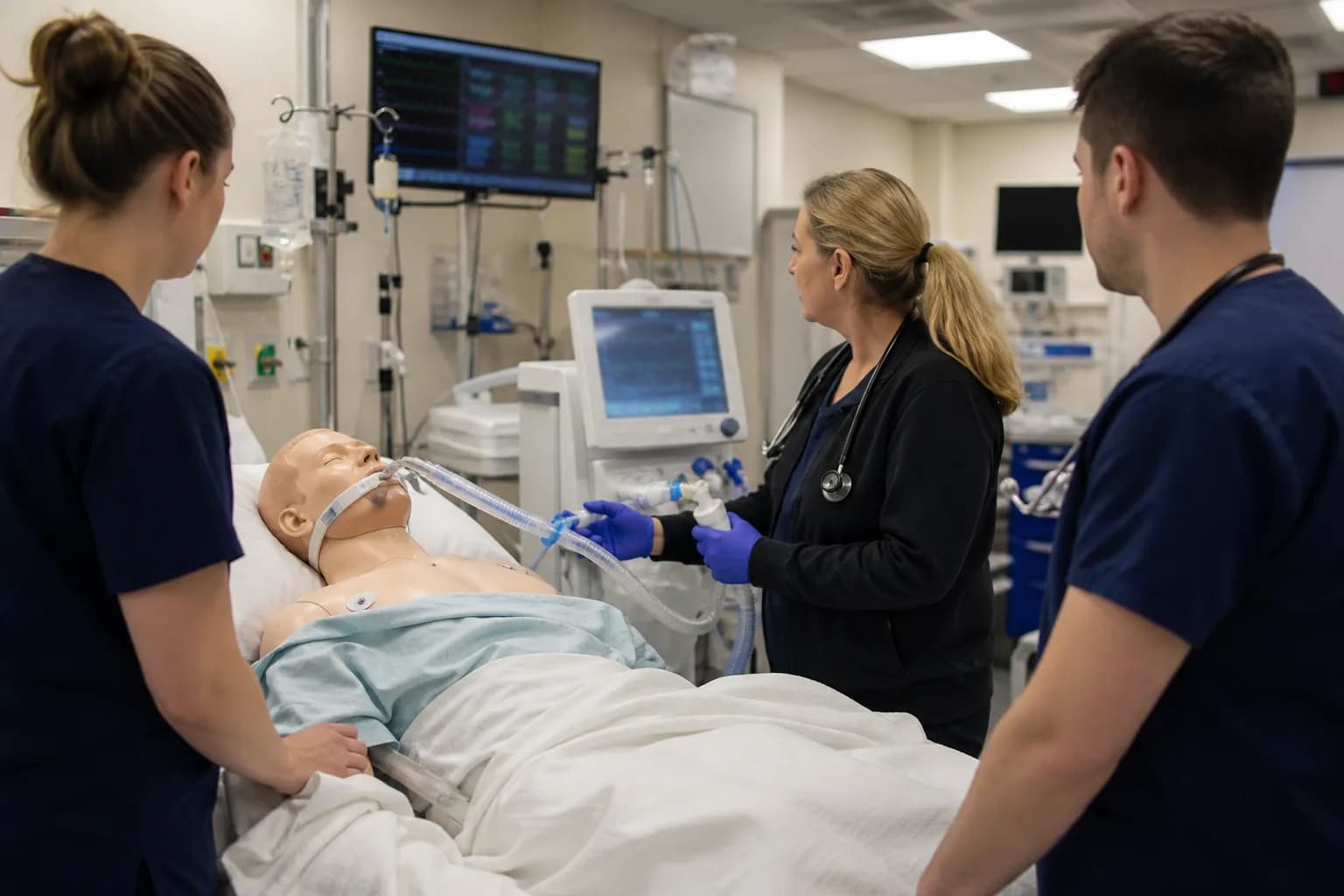
The recurring failure in real events is not absent skill but duplicated and orphaned tasks — three people doing one thing and nobody doing another. Role cards solve this cheaply. Physical cards or coloured tabards assigned on arrival name each position, and each card lists that position's responsibilities in the order they occur. Whoever picks up the card owns the role for that event, which removes the negotiation that otherwise happens in the first thirty seconds.
Define the positions your establishment can actually staff at 3 a.m., not the ideal roster. A team leader, an airway position, a compressions rotation, a drugs and access position, a documentation scribe, and a runner is a common shape, but a small hospital may legitimately combine them. What matters is that the combination is pre-decided rather than improvised, and that the leader position is explicitly hands-off wherever staffing permits, because a leader performing a procedure stops leading.
Rehearse with unannounced mock activations at varied hours, including night and weekend shifts where the team is thinnest. Rehearsal should test the whole chain — the call, the announcement, the route, the trolley, the record — and not just the clinical drill. Debrief mock events as seriously as real ones, since a mock code is the only safe place to discover that the lift key is kept in a locked drawer.

The code documentation record
The event record has three separate audiences and must serve all of them: the clinicians who continue care afterwards, the quality committee reviewing performance, and — if the case becomes contested — a legal reader years later. That argues for a structured, time-stamped record rather than a free-text narrative written after the event. The scribe position exists so that this record is captured live by someone whose only task is capture.
Structure the record around a timeline of discrete entries: activation time, arrival time of each responder, interventions with the time each began, rhythm or status checks, medications administered with time and route, and the time and basis of the outcome decision. Free-text should supplement the timeline, never replace it. Retrospective entries are legitimate and often unavoidable, but they must be visibly marked as late entries with their own authoring timestamp — an amended record that looks contemporaneous is a far bigger problem than one honestly annotated.
Digital capture helps here mainly because it timestamps automatically and preserves an audit trail of edits. HealUDoc can hold the code record against the patient encounter so it travels with the chart into the ICU rather than living as a loose sheet in a folder, while activity logs show who entered and who amended each element. Whatever the medium, decide in advance where the original goes, who files it, and how the quality team retrieves a month's worth without hunting through wards.
Fields a code record should capture as structured data
- Activation time and activation source
- Team arrival time, by responder
- Timed intervention entries with performer
- Medication entries with time, route and administering staff
- Outcome decision, time, and who made it
- Late-entry flag with separate authoring timestamp
Debrief and cart restocking before the unit stands down
Two things must happen before the team disperses, and both are routinely skipped because the emotional pressure to leave is enormous. The first is a short hot debrief — a few minutes, at the bedside or just outside it, covering what went well, what obstructed the team, and any equipment that failed. This is a systems conversation, not a performance review, and it should be facilitated by the team leader with an explicit ground rule that individual conduct is not the subject.
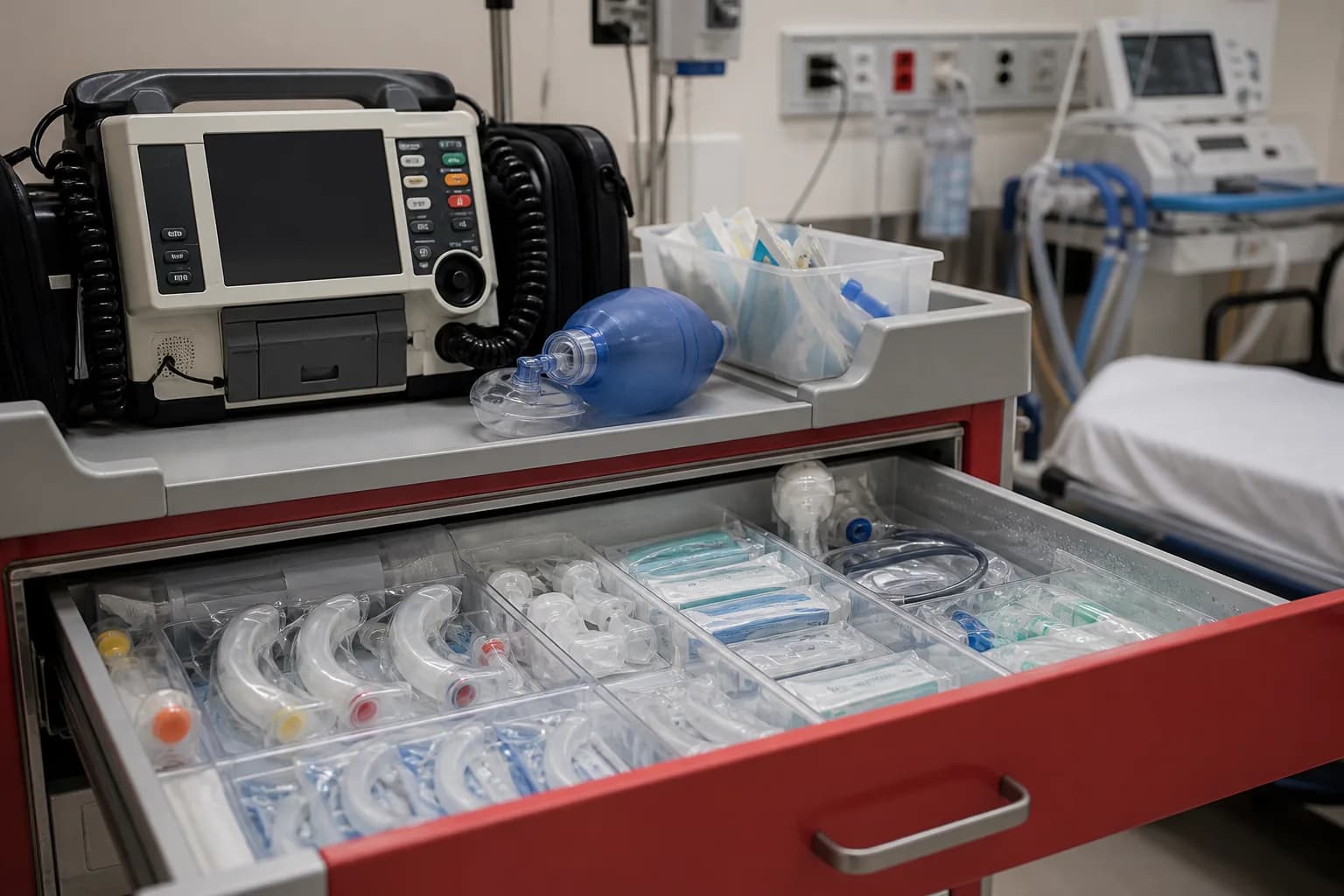
The second is restocking. An emergency trolley that is not restocked and resealed immediately is a latent hazard for the next patient, and the person who knows exactly what was used is the person still standing there. Make restocking an owned role rather than a general expectation, log the reseal with a numbered tamper-evident seal, and record the seal number on the daily trolley check sheet so any break is visible at a glance.
Staff support is the part most policies mention and few operationalise. Events involving young patients, colleagues, or prolonged unsuccessful resuscitation carry real weight, and the ward should have a stated route to peer support that does not require the affected staff member to initiate the request. A named contact and a follow-up conversation a day or two later costs almost nothing and does more for retention in critical areas than most engagement initiatives.
“We used to end a code the moment the patient was moved. Now the event is not closed until the trolley is resealed and the seal number is written down — that single change ended the recurring finding about incomplete carts.”
Measuring response interval without gaming the clock
The headline measure is the interval from activation to team arrival, and it is only meaningful if both endpoints are captured independently of the people being measured. Activation time should come from the paging or call system automatically. Arrival time is harder — a scribe entry is workable, a badge tap at the ward door is better where the infrastructure exists, and a self-reported figure entered after the event is close to worthless.
Report the distribution rather than the average. A mean interval hides the long tail, and the long tail is where the harm sits: a handful of ten-minute responses in a particular block at a particular hour tells you far more than a comfortable overall mean. Break the data by location, shift and day of week, because response failures are usually structural — a specific lift, a specific staffing pattern — rather than randomly distributed.
Balance the interval metric with measures that discourage suppression. Track activation rate per thousand admissions alongside response time, and watch for the pattern where response times improve while call volume quietly falls, which usually means staff have stopped calling rather than that the hospital has improved. Pair both with the proportion of events that had a documented debrief and a resealed trolley, so the quality committee is looking at the whole chain rather than a single flattering number.