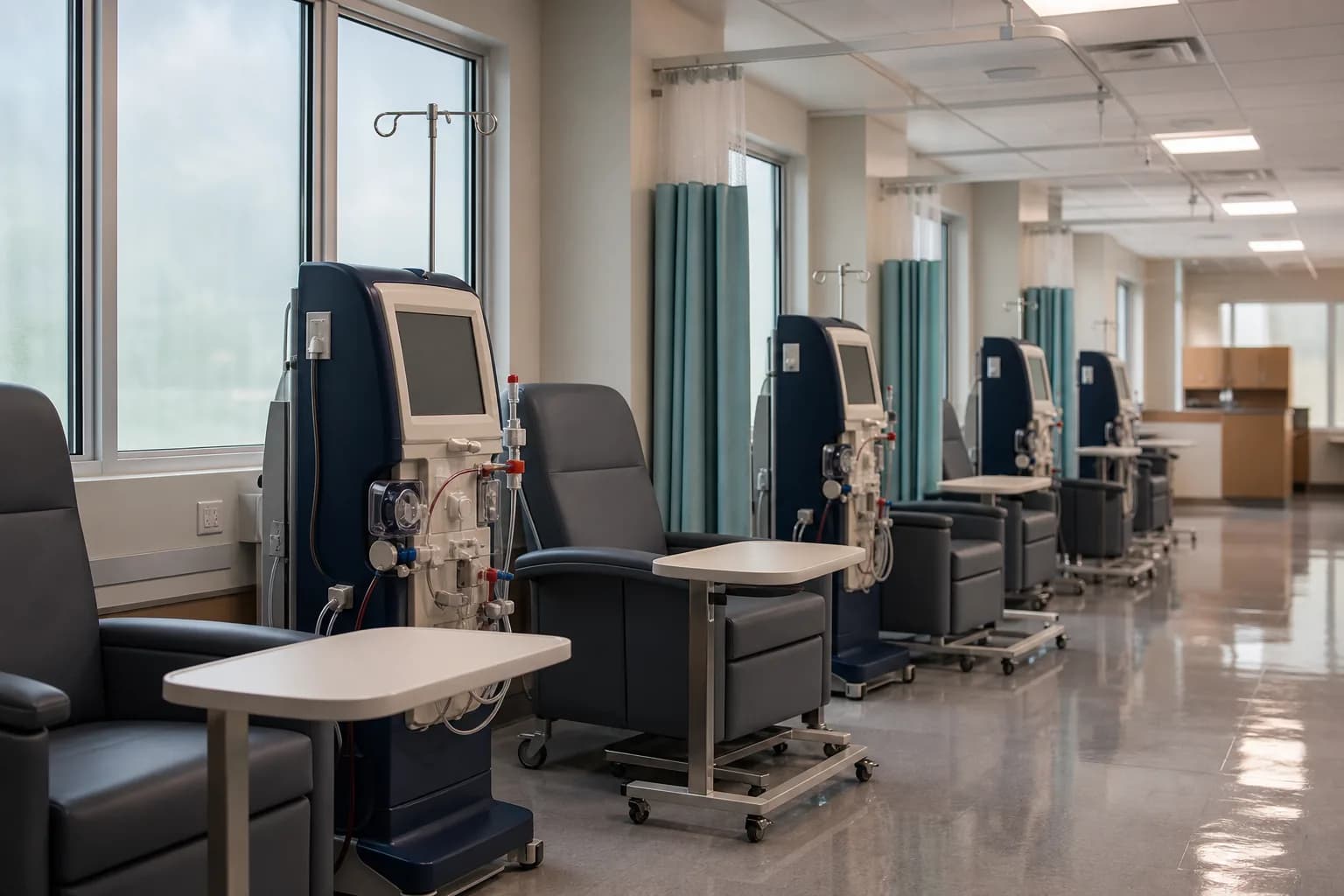
The symptom: empty chairs at nine, chaos at two
Almost every oncology day care unit shows the same daily curve. Chairs sit empty for the first ninety minutes, fill sharply late morning, and then run over into the evening with nurses staying back. Management looks at the average chair occupancy for the day, sees a comfortable number, and concludes there is no problem. The average is hiding a unit that is idle for a quarter of the session and over capacity for another quarter, which is why staff are exhausted and patients still wait.
The cause is almost never the number of chairs. It is that the sequence of events required before a patient can be seated is not scheduled at all. Blood counts have to be drawn and reported, the consultant has to review and authorise, the pharmacy has to receive a released order and compound it, and the drug has to physically arrive. Only the last of those is scheduled. Everything before it is assumed to happen in time, and when it does not, the chair sits empty while the queue outside grows.
Diagnosing this properly means measuring the intervals, not the totals. For a fortnight, capture arrival time, phlebotomy time, report release time, consultant authorisation time, pharmacy receipt, admixture completion, drug arrival on the floor, and infusion start. The interval that dominates will be obvious within a week, and in most units it is the gap between authorisation and drug arrival rather than anything to do with seats.

Reading the day as three queues, not one
A day care unit is three queues stacked on top of each other. There is a review queue, where patients wait for counts and a consultant decision. There is a pharmacy queue, where authorised orders wait for compounding capacity. And there is a chair queue, where compounded drugs wait for a seat and a nurse. Scheduling only the third means the first two absorb all the variability, which is exactly backwards, because they are the ones with no slack.
Once you see it as three queues, the fix is to move work upstream in time rather than to add capacity. Counts taken the previous day for stable patients on well-tolerated regimens eliminate the entire morning review queue for that group. Pre-authorisation the evening before, on the strength of yesterday's counts and a documented review, lets pharmacy start compounding at eight rather than at eleven. Neither of these is a software feature. Both need a written clinical policy defining who is eligible.
The policy is where the trade-off lives. Pre-day counts mean a small proportion of patients will arrive with a compounded drug they cannot receive, and a compounded cytotoxic that goes unused is money burned and a waste-handling problem under the Bio-Medical Waste Management Rules. Units have to decide which regimens and which patient groups are stable enough to justify that risk, and then measure the wastage rate honestly rather than pretending it is zero.
Intervals worth measuring before changing anything
- Registration to phlebotomy completion
- Phlebotomy to haematology report availability
- Report availability to consultant authorisation of the order
- Authorisation to pharmacy receipt of the released order
- Pharmacy receipt to drug arrival on the day care floor
Pharmacy admixture is the real constraint
A cytotoxic admixture unit with two trained pharmacists and one biological safety cabinet has a fixed hourly throughput, and that throughput, not chair count, sets the shape of the day. Compounding is sequential inside a cabinet, cleaning between preparations takes time, and some preparations take considerably longer than others. If your scheduler releases twenty orders at eleven o'clock, the twentieth patient will be seated in the late afternoon regardless of how many chairs are free at noon.
The scheduling model that works treats the cabinet as the booked resource. Each protocol carries an estimated compounding time, orders are released into pharmacy in a sequence that matches the intended seating sequence, and the day care board shows pharmacy progress so nurses can see what is coming rather than telephoning. This is a modest amount of configuration and it changes the unit's behaviour more than any other single intervention.
The limits are worth stating. Compounding time estimates drift, urgent additions jump the queue, and a single cabinet failure removes the entire capacity for the day. Every unit needs a documented fallback, whether that is a validated outsourcing arrangement, a deferral protocol for non-urgent regimens, or a second cabinet that is under-utilised on purpose. Running a single point of failure with no plan is common, and it is the reason units occasionally cancel a full list.

Building the appointment from the protocol
An oncology appointment should be generated from the regimen, not typed into a calendar. When a patient is started on a protocol, the system knows the cycle length, the days within the cycle on which drugs are given, the expected chair time for each of those days, and the pre-treatment investigations due before each. From that, the entire course of appointments can be laid out at the start, with the investigations booked to fall on the right day relative to treatment.
This is what makes day-of-cycle rules enforceable. If a regimen is given on days one and eight of a twenty-one-day cycle, the software should know that today is day eight of cycle three and refuse to accept an order written as day one. It should also carry the permitted window, because real cycles slip and a rigid system that treats a two-day delay as an error will simply be worked around. Configure the tolerance explicitly rather than leaving it to interpretation at the desk.
The chair time estimate matters more than people expect. A short push and a five-hour infusion with hydration cannot occupy the same slot length, and units that book every patient into a uniform slot spend the day either wasting chairs or overrunning. Carry the expected duration on the protocol, including pre-medication and post-infusion observation, and let the booking use it. HealUDoc can hold the regimen definition with its per-day chair duration so the schedule is generated rather than estimated by whoever answers the phone.
What a protocol definition should carry for scheduling
- Cycle length and the treatment days within the cycle
- Expected chair occupancy per treatment day including pre-medication
- Estimated admixture preparation time per drug
- Pre-treatment investigations and how many days before they are valid
- Permitted delay window before the cycle counts as deviated
Nurse load balancing and acuity
Chair-to-nurse ratios computed on a headcount are misleading, because a first-cycle patient on a regimen with a high reaction risk needs continuous attention while a fourth-cycle patient on a well-tolerated maintenance drug largely needs a functioning cannula. Assigning nurses to chairs geographically produces a unit where one nurse is running and another is idle six feet away. Assign by acuity weight instead, computed from the regimen, the cycle number, and the patient's history of reactions.
The weighting scheme should be simple enough that the in-charge can override it and explain why. Three tiers is usually enough. What matters is that the day's booking screen shows the acuity load per nurse for each hour, so that the person building the list can see at ten in the morning that the two o'clock slot has three high-acuity starts on one nurse. That is a fixable problem at ten and an incident at two.
There is a workforce dimension nobody enjoys discussing. Cytotoxic handling requires trained staff with documented competency and periodic health surveillance, and the pool of nurses qualified to administer is smaller than the pool on the roster. When your acuity model assumes six administering nurses and you actually have four with current competency records, the schedule is fictional. Keep the competency register linked to the roster so the constraint is visible when the list is built.
“We added four chairs and nothing improved. Then we moved two pharmacists to start at seven-thirty and released half the orders the previous evening, and the same unit ran an hour shorter with the original chairs.”
Deferrals, dose delays, and the mid-day reshuffle
A proportion of patients will be deferred every day on counts, renal function, mucositis, or a fever, and the schedule must be built to absorb that rather than to be surprised by it. Track your deferral rate by regimen. Once you know that a given protocol defers a meaningful share of patients at a given cycle number, you can overbook that slot deliberately, the way an airline does, instead of leaving a hole and then working late to fill it.
The deferral itself needs a proper record, not a cancelled appointment. Capture the reason, the value that triggered it, the decision maker, the dose modification if any, and the new date, and carry those forward so the next cycle's clinician sees the pattern. A patient deferred three times in a row for the same reason has a clinical problem that a cancellation log will never surface, and dose intensity across the course is a real outcome variable that most units cannot report on.
When a deferral happens after compounding, you have a wastage event that should be logged as such. Reconstitution wastage is a genuine cost line and a safety issue, and units that record it find that a small number of regimens and a small number of prescribers account for most of it. That is an actionable finding. A total wastage figure with no attribution is not.
What to capture on every deferral
- The parameter and value that triggered the deferral
- Who made the decision and at what time relative to compounding
- Whether the drug had already been prepared, and the wasted quantity
- The dose modification carried into the rescheduled cycle
- The new date and whether it stays within the protocol window
Knowing whether the schedule actually improved
The measures that matter are all intervals and distributions, never averages. Track median and ninetieth-percentile time from arrival to infusion start, the proportion of days where the last infusion finishes after the rostered shift end, the chair occupancy profile by hour rather than by day, and the same-day deferral rate split into deferrals before and after compounding. Four numbers, reviewed weekly at a short operational meeting, will tell you more than a monthly dashboard nobody opens.
Set the improvement target on the tail, not the middle. A unit whose median waiting time is ninety minutes and whose ninetieth percentile is four hours has an experience problem concentrated in a minority of patients, and those are the patients who complain, who miss transport, and who default on the next cycle. Reducing the tail usually means fixing the late-morning order release, which brings you straight back to the pharmacy queue.
Finally, resist the urge to judge the unit on throughput alone. Oncology day care that runs to time by rushing pre-treatment checks has not improved. Pair every flow measure with a safety measure, such as the proportion of administrations with a documented independent double check, so that the operational gain is visibly not being bought from the safety budget. If the two move in opposite directions, the schedule change was not a success.