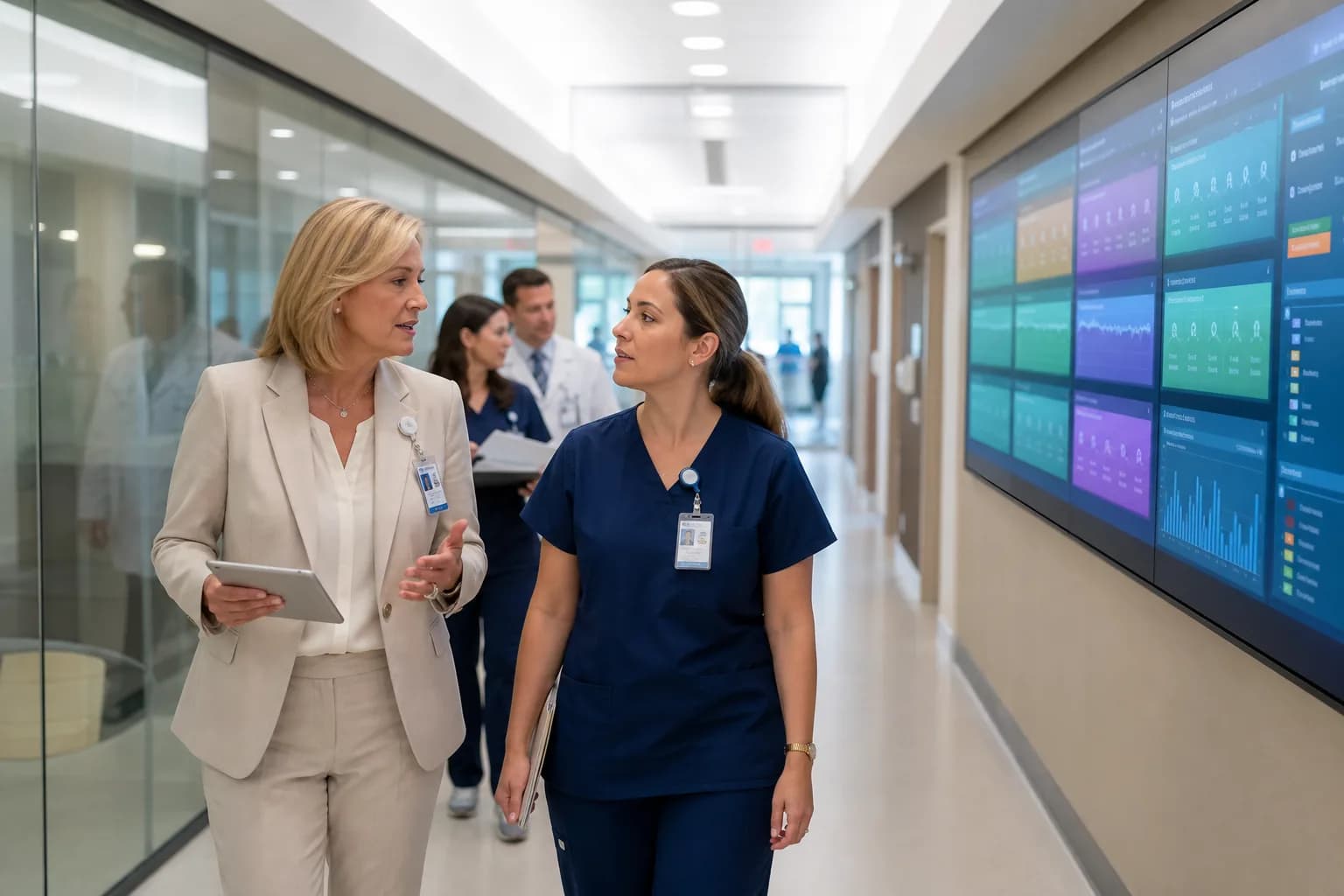
What a hospital command centre is, and what it replaces
A hospital command centre is a room where live operational signals from across the hospital are visible in one place, staffed by people who can act on what they see. It replaces the phone tree — the sequence of calls between the emergency department, the bed manager, the ward sister, housekeeping, and the admitting consultant that currently resolves every flow decision, slowly and with information decaying at each hop.
The core insight is that most patient-flow delay is not caused by absent capacity but by absent information. A bed is free, but the ward has not communicated it; housekeeping has cleaned it, but the bed manager does not know; a patient is medically fit for discharge, but the summary is pending and nobody is chasing it. Each of these is a visibility failure with a queue of real patients behind it.
This is also why a command centre is not a dashboard on a big screen. The screen is the cheapest component. What makes it a command centre is that someone is looking at it continuously, has a defined response to what appears, and has the authority to make that response happen without a round of negotiation.
Which live signals belong on the wall
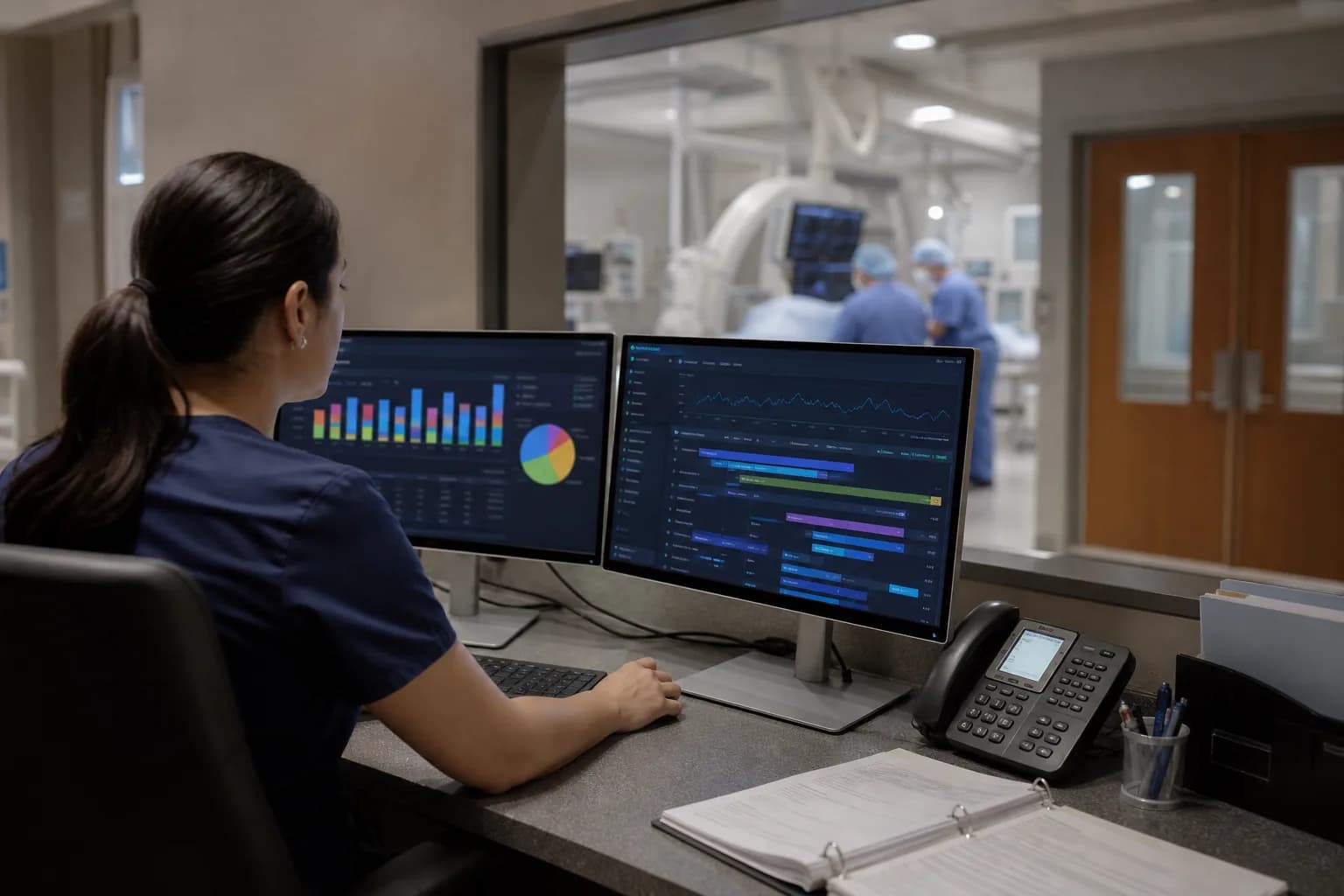
The selection test is strict: a signal earns wall space only if someone in the room would act differently within the hour based on it. Everything else belongs in a report. Applied honestly, this test eliminates most of what teams initially propose, and the resulting sparse wall is far more effective than a dense one nobody can parse at a glance.
The signals that survive are the ones describing flow in and out. Bed status by ward — occupied, vacant and clean, vacant and awaiting housekeeping, blocked. Emergency department load with waiting counts and longest wait. Theatre running state against schedule, with over-runs visible. The discharge pipeline: patients marked medically fit, and where each is stuck — summary pending, billing clearance pending, transport pending, family pending. Critical care occupancy and any pending transfer requests.
Present each as current state plus a short trend, because a number without direction is hard to act on. Twelve patients waiting in the emergency department means something quite different when it was six an hour ago than when it was twenty. Where these signals come from a single operational platform such as HealUDoc, the wall reflects the same records the wards are working in, which removes the argument about whether the screen is current.
Signals that earn a place on the wall
- Bed status by ward, including cleaning and blocked states
- Emergency department census, waiting count, and longest wait
- Theatre running state against the published schedule
- Discharge pipeline with the specific blocker per patient
- Critical care occupancy and pending transfer requests
- Diagnostic turnaround for the tests that gate discharge
Alert thresholds, and who acts on each
An alert without a named owner is noise, and noise trains people to ignore the wall. Every threshold must be written as a triple: the condition, the person who responds, and the action they take. Emergency department waiting exceeds a defined count for thirty minutes — the flow coordinator contacts the on-call physician and escalates to the duty medical officer if unresolved. Not merely a red cell.
Set thresholds where the response is still useful. A threshold that fires when the situation is already unrecoverable is a status indicator, not an alert. This usually means setting them earlier than instinct suggests and accepting some alerts that turn out not to need action — the alternative, tuning for zero false alarms, produces a system that only tells you about crises you had already noticed.
Then review firing rates monthly and prune. Any alert that fires constantly has become wallpaper and either needs its threshold raised or represents a chronic problem that a real-time alert cannot solve — a permanently over-capacity ward needs a capacity decision, not a daily notification. Any alert that has never fired should be tested, because untested alerts are usually broken.

The operating rhythm around the screens
Screens do not run a hospital; meetings do, and the command centre's real product is a tightened operating rhythm. The typical structure is a short morning huddle that sets the day's plan against predicted demand, a midday checkpoint that verifies discharge progress against the morning's commitments, and an evening handover that transfers the state of open issues to the night team.
Keep each session short and structured. Fifteen minutes, standing, working from the same screens, covering the same items in the same order: yesterday's exceptions, today's predicted pressure, current blockers by patient, and named actions with times. The value comes from the consistency rather than the depth — a fifteen-minute meeting every day beats an hour-long one every week for anything flow-related.
Attendance must include people who can decide. Bed management, emergency, theatres, nursing, housekeeping, pharmacy, and discharge coordination all need a representative empowered to commit their function. A huddle attended by observers who must go and ask produces a list of things to be checked rather than a set of resolved decisions, and it will be abandoned within a quarter.
Authority is the load-bearing element
Command centres fail for one dominant reason, and it is not technical. The room can see everything and change nothing. The flow coordinator observes that a ward is holding a bed for an expected admission that has not confirmed, or that a discharge has been blocked for six hours on a pending summary, and can do nothing but request. Requests queue behind everything else the ward is doing.
Fixing this requires an explicit delegation from executive leadership, written down and communicated. Typically the command centre gets authority to allocate beds across wards within defined rules, to escalate a blocked discharge directly to a consultant after a stated interval, to trigger housekeeping priority, and to convene an escalation call that department heads are required to join. The boundaries matter as much as the powers — clinical decisions remain clinical.
The test is what happens on the first real conflict. When a ward declines a command centre allocation and the executive backs the ward without a clinical reason, the centre's authority is finished and the staff will know within a day. Leadership must be willing to enforce the delegation the first few times it is tested, or not make it.
Authority worth delegating explicitly
- Bed allocation across wards within agreed clinical rules
- Escalation of a blocked discharge directly to the responsible consultant
- Priority tasking for housekeeping and portering
- Convening a mandatory escalation call at a defined trigger
- Temporary hold on elective admissions at a defined occupancy level
Data foundations: latency, source of truth, and honesty
Real-time operations demand different data engineering from analytics. A warehouse refreshed nightly is useless here; the wall needs latency measured in minutes at most, drawn from the operational system directly or from a streaming path beside it. This is one of the few places where reading from the transactional system is defensible, provided the queries are narrow and indexed.
Every tile needs one unambiguous source. If bed status is maintained both in the ward's whiteboard practice and in the system, the wall will show one and the ward will believe the other, and the centre's credibility dissolves. Retiring the parallel record is a precondition for the screen mattering, and it is usually the hardest part of the implementation.
Show data age on every tile. A wall that displays a stale value indistinguishably from a live one is worse than one that says clearly that theatre status has not updated in twenty minutes — because the staleness itself is actionable information, usually meaning an interface has failed. Making that visible converts a silent failure into an alert.
Phasing: start with one flow, prove it, extend
Attempting a full command centre in one project is how hospitals end up with an expensive room and a poor reputation for the idea. Start with the single flow causing the most pain — usually emergency to inpatient bed, or discharge before noon. Instrument only that flow, put a coordinator on it, define three or four alerts, and run a daily huddle around it for a quarter.
Measure the flow you targeted, not the room. Time from admission decision to bed allocation, time from medically fit to actual discharge, proportion of discharges completed before a target hour. If those move, the case for extending is made in the hospital's own numbers. If they do not, you have learned something important for a fraction of the cost of a full build.
Extend by adding one flow at a time, reusing the same rhythm and the same coordinator role. Theatre utilisation, diagnostic turnaround, and transfer coordination each slot into an established operating pattern more easily than they would into an empty room. A command centre grown this way arrives with its authority already demonstrated, which is the component that cannot be purchased.
“For the first six months we could see every blocked discharge and could not move a single one. The screens only started working the week the medical director told the wards that the coordinator's bed allocation was final.”