What an ambient AI scribe does, and what it does not
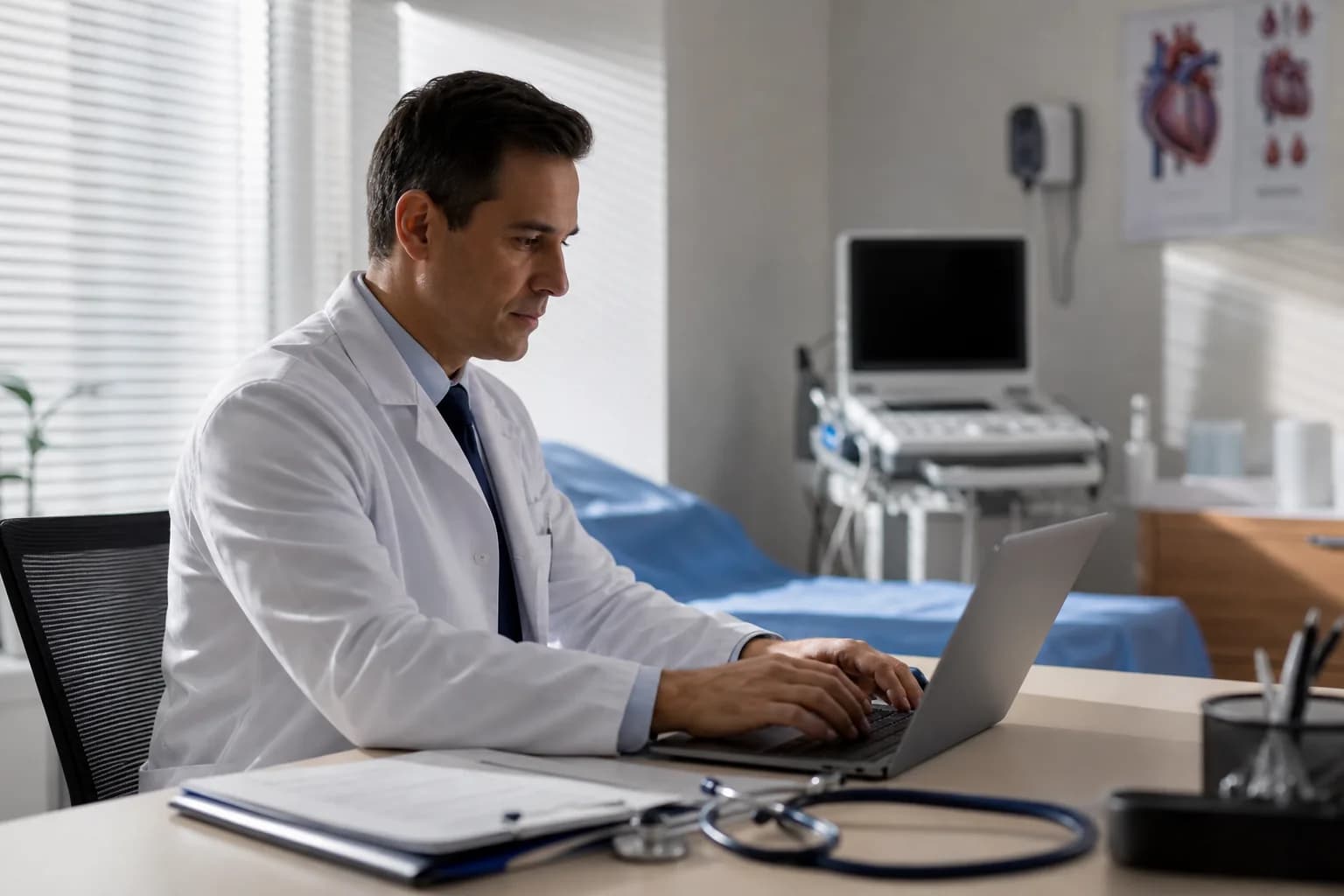
An ambient AI scribe listens to a clinical encounter, transcribes it, and produces a structured draft note — typically a history, examination, assessment, and plan — that the clinician then reviews and signs. The word that carries all the weight in that sentence is draft. What the system produces is a proposal about what was said; what enters the record is what the clinician verifies and attests to.
This distinction is not a legal technicality. Ambient AI scribes for clinical documentation generate text that reads fluently and confidently whether or not it is accurate, which makes review harder rather than easier. A garbled transcription is obviously wrong; a plausible, well-formed sentence describing an examination finding that was never stated is not.
It is also worth being clear about what these tools do not do. They do not decide, they do not code reliably without review, and they do not remove the clinician's responsibility for the content of the record. Hospitals that deploy them as a labour replacement rather than a drafting aid are taking on a risk they have not measured.

Where the benefit is real
The clearest benefit is in encounter types that are verbal, narrative, and repetitive: outpatient consultations, follow-up reviews, and admission histories. In these settings a significant share of a clinician's documentation effort is transcribing a conversation that has just happened, and shifting that effort to review rather than composition is a genuine change in the nature of the work.
There is a second, less-discussed benefit: attention. A clinician typing while a patient speaks is dividing attention, and consultations where the clinician faces the patient throughout are qualitatively different. Several hospitals report this as the change staff notice first, ahead of any time measurement.
The benefit is much weaker elsewhere. Procedural documentation, theatre notes, and structured nursing observations are already form-driven and are not improved by narrative generation. Emergency and critical care environments have acoustic conditions and interruption patterns that degrade transcription accuracy substantially. Scope deployment to where the mechanism actually applies.
Settings where ambient capture tends to work well
- Outpatient consultations with a single primary speaker pair
- Follow-up reviews with a predictable narrative structure
- Admission histories taken in a quiet setting
- Specialties with stable, well-covered vocabulary
- Encounters where the clinician already dictates rather than types
Clinician-in-the-loop review is the entire control
The safety of the whole arrangement rests on the review step, so it must be designed rather than assumed. Reviewing a fluent draft against memory of a consultation is a genuinely difficult cognitive task, and it degrades with fatigue, volume, and time elapsed since the encounter. Review at the end of a clinic list is materially less reliable than review immediately after each patient.
Design the interface to support verification rather than approval. Surfacing the source audio segment or transcript alongside each generated statement lets a clinician check a specific claim quickly. Highlighting content the model generated with low confidence, and flagging clinically consequential elements — medications, doses, allergies, negations, and numbers — for explicit confirmation, focuses attention where errors matter.
Make the audit trail unambiguous about authorship. The record should show that a draft was machine-generated, what the clinician changed, and that the clinician attested to the final version. HealUDoc activity logs can distinguish generated content from clinician-authored edits so a later reviewer can see exactly what was accepted rather than having to infer it.
Consent and privacy obligations under the DPDP Act
Recording a clinical encounter processes personal data, and under the DPDP Act 2023 the hospital as data fiduciary must have a lawful basis, give clear notice, and limit processing to the stated purpose. Patients should be told before the consultation that the encounter will be recorded for documentation purposes, by whom it will be processed, how long the audio is kept, and that they may decline without any effect on their care.
Declining must be operationally real. If the only workflow available requires recording, the consent is nominal. Clinicians need a one-click way to proceed without ambient capture, and staff need to know that a patient's refusal is a normal outcome rather than a problem to be talked around. Recording the patient's decision against the encounter, as HealUDoc consent handling allows, means a later query can show which notes were produced with ambient capture and which were not.
Then there is the vendor. Ambient tools typically process audio outside the hospital's own systems, which raises data localisation, sub-processing, retention, and model-training questions that belong in the contract, not in a sales conversation. Establish in writing whether your data may be used to train or improve models, where it is processed, how long audio and transcripts persist, and what happens to all of it on termination.
Contract and privacy questions to settle in writing
- Whether hospital data may be used for model training or improvement
- Where audio and transcripts are processed and stored, and under what jurisdiction
- Retention period for audio, transcripts, and derived text, and deletion proof
- Sub-processors used, and notification obligations when they change
- Breach notification timelines and the hospital's audit rights
Accuracy failure modes worth knowing about
Errors from these systems are not randomly distributed, and knowing the patterns makes review far more effective. Negation handling is a recurring weakness: a note that records a symptom as present when the patient denied it inverts the clinical meaning entirely. Numbers and units are another, particularly doses and frequencies spoken quickly.
Attribution errors occur when multiple people speak — a family member's account can be recorded as the patient's, or a student's suggestion as the consultant's assessment. Code-switching between English and a regional language mid-sentence, which is entirely normal in Indian consultations, degrades accuracy in ways that vendor demonstrations rarely exhibit. So do names, drug brand names in local usage, and speech from patients with respiratory difficulty.
The most consequential failure mode is confident generation of content that was not said at all, particularly filling in a normal examination that never occurred because the model has learned that such text usually follows. Any evaluation that does not specifically test for this is not an evaluation.

“The transcription mistakes we caught easily. What worried us was a tidy examination paragraph for a finding the doctor had never mentioned out loud.”
How to evaluate before committing
Evaluate on your own encounters, in your own acoustic conditions, with your own accents and language mix. A vendor demonstration on scripted English audio tells you nothing about performance in a busy OPD where the consultation moves between two languages. Insist on a pilot with your recordings before any commitment.
Define the measures in advance and score blind. Useful measures include the proportion of notes signed without any edit, the rate of clinically significant errors found by an independent reviewer, the specific rate of fabricated content, and the time from encounter end to signed note. Clinician-reported burden matters too, but should not be the only evidence, because novelty inflates early enthusiasm.
Run the pilot long enough for the novelty to wear off — a few weeks is not enough. The question you are answering is whether clinicians still review carefully at week twelve, when the tool has been mostly right for three months and the review has started to feel like a formality. That is the point at which the control either holds or quietly stops working.
Deciding whether it is worth it for your hospital
A measured decision weighs a real reduction in documentation burden against a new review obligation, a new vendor dependency, and a new category of privacy exposure. For a hospital whose clinicians are drowning in outpatient documentation, that trade can be clearly favourable. For one whose main documentation problem is incomplete nursing records or poor discharge summaries, ambient scribing addresses the wrong bottleneck.
Diagnose the actual constraint before shopping. If notes are late because clinics overrun and there is no protected documentation time, a scribe compresses the task but does not create the time. If notes are poor because templates are badly designed, fixing templates is cheaper and more durable.
Where you do proceed, proceed narrowly and honestly: a defined specialty, willing clinicians, explicit patient notice, measured outcomes, and a stated point at which you will stop if the evidence does not support continuing. That posture is not scepticism about the technology; it is the ordinary standard for introducing anything into clinical practice.